
Inside: 10 gentle baby sleep training strategies that will help baby sleep longer stretches at night and eventually all night long (No Ferber method or “Cry It Out” necessary)
If you’ve found yourself here, chances are you’re sleep-deprived, running on caffeine and wondering if you’ll ever get a full night’s sleep again. More importantly, you’re probably hoping your baby will let you!
Maybe you’re not even dreaming of eight uninterrupted hours — maybe you’d just love more than a 90-minute stretch without waking!
I get it. I’ve been there. I need sleep the way I need air… and coffee… and yes, chocolate. A lot of chocolate.
In this post I’ll share my tried and tested gentle baby sleep training strategies that had all 4 of my kiddos sleeping through the night when they were developmentally able to (from 12 weeks to 6 months in case you’re wondering).
To clarify “gentle” baby sleep training means you don’t need to leave your baby to cry at any point (often termed “cry-it-out” or “Ferber method”).
However, before we dive headfirst in, there are a few helpful things to know about how newborn sleep actually works.
Because once you understand why your baby sleeps like a nocturnal squirrel and how that gradually changes, everything starts to make a little more sense.
But if you’re running on empty and need answers right now, feel free to jump ahead to the 10-step baby tips using the table of contents.
This post contains affiliate links. If you click on one and make a purchase, I may receive a commission at no extra cost to you.
Why Baby Sleep Is So Important
If you’re running on fumes, you already know how critical sleep is — but for babies, it’s even more essential. Their bodies grow and brains develop during sleep. It’s when memory consolidates, cells regenerate, and growth hormones kick in.
Fussiness, exessive crying, short naps and frequent wakeups may indicate your baby is not getting enough sleep. While a baby that is well rested tends to be content and happy!
So it’s a little bit of a no brainer to encourage your baby to sleep well and get the right amount of sleep for their age.
(This post will cover developmentally appropriate sleep and nap times.)
Understanding How Babies Sleep (It’s Not Like Us)
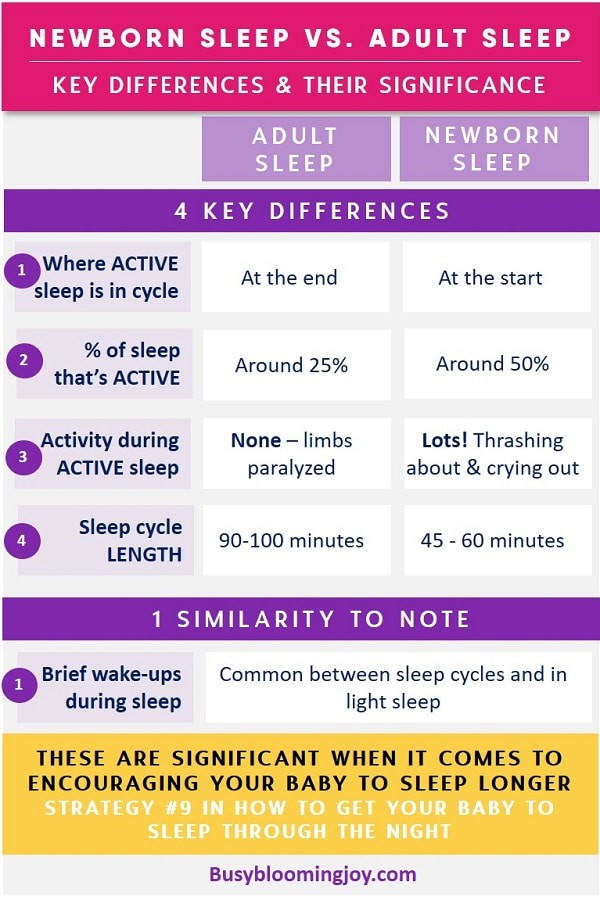
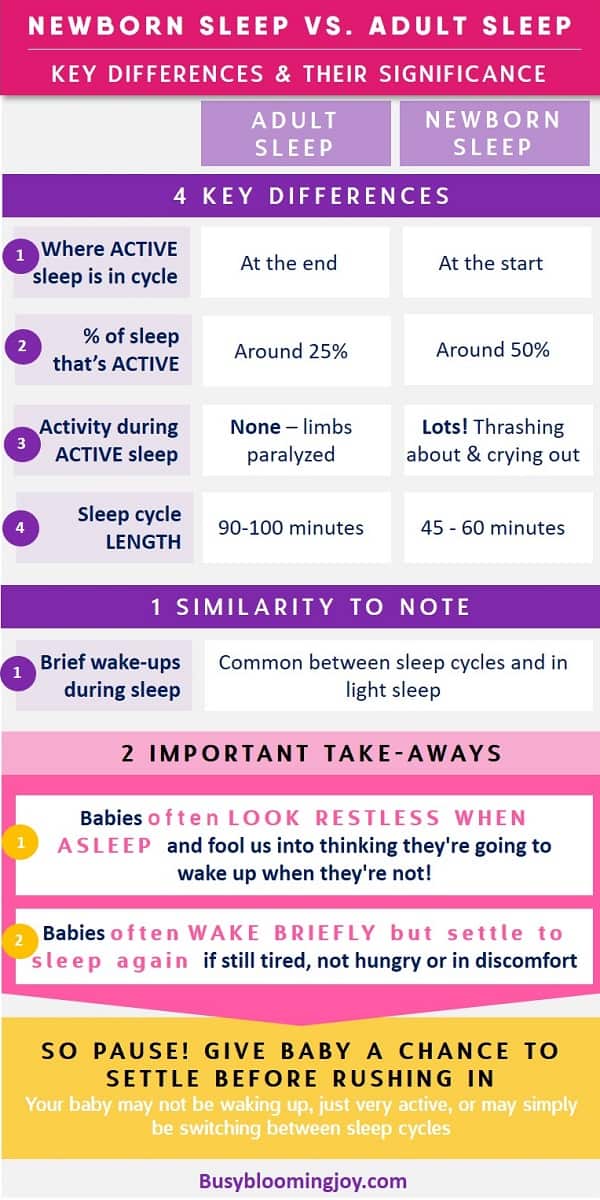
Newborns go through cycles just like adults — light, deep, and active sleep — but their cycles are shorter and their sleep is far lighter.
In fact, neworn babies spend about 50% of their sleep in “active” mode (the baby version of REM), where they twitch, grunt, wriggle, and sometimes cry out.
This often tricks us into thinking they’ve woken up — when really, they’re just moving through a normal cycle. Knowing this can save you from rushing in and accidentally waking a baby who was about to settle back to sleep.
(See Strategy #9 — it’s a game-changer.)
More info on newborn sleep patterns here and the below chart summarises these key differences:
What Counts As “Sleeping Through the Night”?
It’s not necessarily 12 uninterrupted hours. For a young baby, even a 6–8 hour stretch is a huge win. And in my book that counts, because that gives you a pretty good night’s sleep.
With my first, it was 11 p.m. to 7 a.m. by 11 weeks. My second managed something similar by 12 weeks, even with reflux.
My twins were a little slower, by 20 weeks, but they were small at birth and a month premature.
They all started bedtime around 7 p.m, with a quick “dream feed” around 10/10:30 p.m. — one of the most effective tools we used (more on that in Strategy #7).
And just to clarify — when I say “sleeping through the night,” I mean in their own crib or bassinet, not being held or bed-sharing.
When Can Babies Sleep Through the Night?
There’s no universal answer, but many babies are physically capable of longer sleep stretches between 6 weeks and 3 months.
What holds them back often isn’t hunger — it’s the need for help in getting back to sleep during light or transitional stages.
If a baby can fall asleep without feeding, rocking, or bouncing every time, that’s when the real magic happens. Self-settling is one of the biggest predictors of longer night sleep.
If a baby can fall asleep without feeding, rocking, or bouncing every time, that’s when the real magic happens. Self-settling is one of the biggest predictors of longer night sleep.

What About Breastfed Babies?
This gentle baby sleep training method works for breastfed babies too.
I breastfed my first 2 long past the point when they started sleeping through, as did many moms I spoke to regarding their own baby sleep experience.
How My Babies Slept Through (Eventually)
My first baby was relatively easy — he started falling asleep on his own around 7 weeks and slept through by 11. Not by chance — I was obsessive about figuring out what worked.
My second baby, on the other hand, had reflux, hated being put down, and woke often. I used the same core strategies but had to adjust and be more patient. She first slept through at 12 weeks, and things got a lot smoother once solids helped settle her reflux, around 8 months.
The twins…. well, I’m hazy on the details to be honest! (I first wrote this post before they were born…) But my bigger boy twin was sleeping through by 16 weeks (he was mainly in with my husband) while for my little girl twin, it was around 20 weeks.
A Quick Word Before We Dive In
I’m not a certified expert — just a sleep-deprived parent who spent way too many late nights reading, testing, and learning what actually helps babies sleep better. These strategies have worked for all of my children, and for plenty of others I’ve shared them with.
That said, every baby is different. There’s no single “right way” — just what works for you and your family. But if better sleep is the goal, this is a great place to start.

THE 10 STEP STRATEGY for Baby Sleep Training (No Cry It Out!)
1: Swaddle Your Baby For a Good Nights Sleep
What is swaddling?
Wrapping baby tight and snugly, like a burrito!
WHY this helps
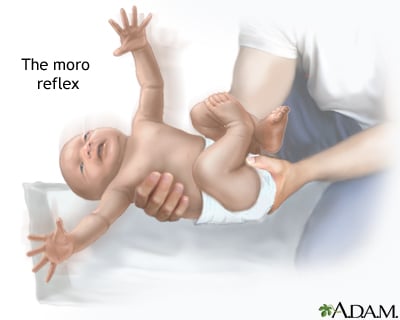
It prevents the Moro (startle) reflex from jolting your baby awake.
These are natural reflexes that babies are born with that can turn your sleeping little beauty into a startled starfish!
How to swaddle
Sign up for our free swaddle course, (with videos, printables) to master tight and secure swaddles — even for escape artists.
If your baby seems to hate swaddling, hang in there — the techniques I learned kept even my Houdini-like baby snug.
2: Follow a Simple Cycle: Feed → Awake/Active → Sleep
In short
Feed, wake for activity, then back to sleep.
Why this helps
- Baby feeds when most alert, encouraging fuller feeds
- A separation between feeding and sleep helps avoid a feeding to sleep association
How to do it
- Wake your baby (yes, sometimes you need to!)
- Change nappy (helps ensure baby is alert to feed well)
- Feed
- Awake / active — not long, depending on age (more on this later)
- Check nappy
- Swaddle
- Take to sleep environment
- Back to sleep
Early on, this cycle might only last 45 minutes; but as baby grows, it stretches — eventually up to 2 hours.
Tips
Ensure awake periods aren’t too long (most under‑3‑month babies max out at ~2 hours awake)
Don’t worry if awake time is short initially: tiny babies are not awake very much at all.
This is only a problem if your baby is awake for long periods at night but cannot manage time away in the day. f this is the case your baby may have days and nights confused.
3. Offer Plenty of Daytime Feeds (Between 7am and 7pm)
Why this works
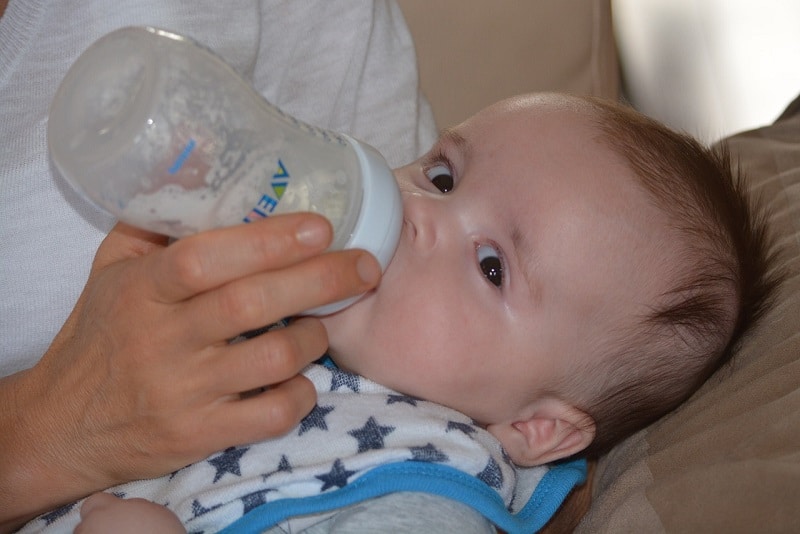
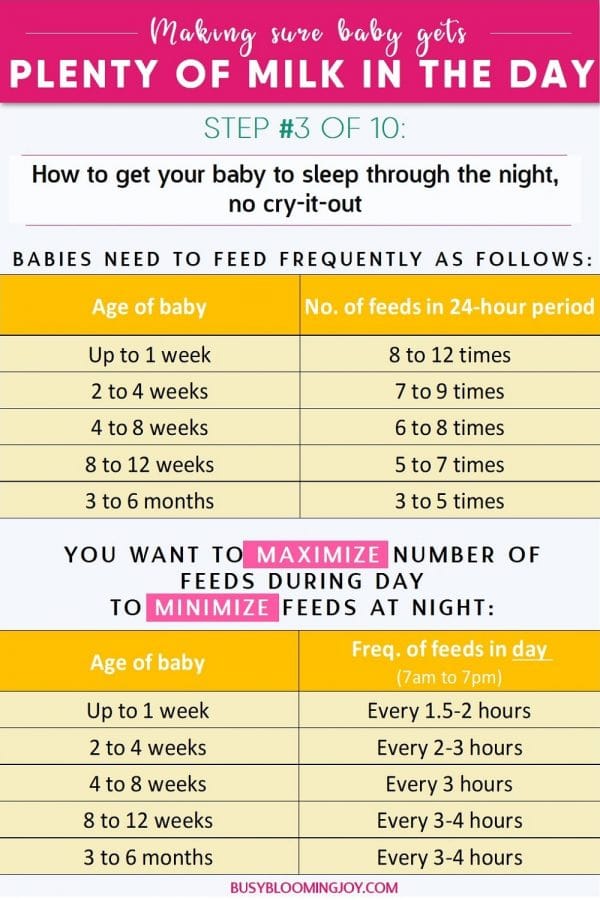
The goal here is simple: maximize feeds during the day so your baby doesn’t wake hungry at night.
How to do this
Aim for feeds every 2–3 hours* between 7am and 7pm. This means waking your baby if necessary! Don’t be afraid to gently rouse them, change their diaper, take a layer off etc so they’re awake enough to feed well.
*Time feeds from the start of one feed to the start of the next. So if your baby takes 45 minutes to feed, there’s about 1 hour and 15 minutes before the next one should begin.
The table below is a good rule of thumb for the TOTAL feeds your baby is likely to need in a 24 hour period:
Baby feeding more frequently?
Encourage bigger feeds.
This should mean baby can last a little big longer until the next feed. In turn, this will encourage a bigger feed at the next feed. Quickly you will find the intervals between feeds increasing.
Watch for comfort feeding.
Try to only feed baby when hungry as a too full tummy can become uncomfortable. (A baby 6+ weeks old and rooting to suck could be seeking comfort. Unless you’re sure they’re hungry, try to calm baby using other methods: swaddling, colic hold, carry them in a sling.)
Stretch out the feeds as per above chart
So you’re feeding every few hours, as per the guide above. You’ll then be on a loose and flexible feeding schedule (always feed baby if you’re sure they’re hungry).
Tips for success
- Track feeds. Use an app/make a note on when your baby last fed — it’s easy to lose track when you’re sleep-deprived!
- Encourage bigger/full feeds. As above, bigger feeds = longer intervals = better sleep potential.
- Ignore the old advice that says, “never wake a sleeping baby.” During the day and in those early days and weeks, it’s often necessary in order to maximise calorie intake in the day.
If you want something a bit more structured, with set feed times, to help ensure baby feeds enough in the day, you may want to try this sleep and feeding schedule.

4: Keep Daytime Sleep (7am – 7pm) in Check
Why this works
Too much sleep in the day = baby wants to party all night.
Wake that baby up in the day if you need to!
In addition, if baby sleeps too much, he or she will not be getting enough milk in the day and will have to catch up at night.
Enough naps in the day = well rested, happy baby that shouldn’t fight bedtime.
This may seem counter-intuitive – you want your baby to sleep all night long. Surely that’s more likely if they’ve been awake all day?
Wrong.
Overtired babies can be impossible to settle and are more likely to wake frequently at night.
More on why this happens in this overtired baby post.
How to do it
Following the schedule of milk, awake/active, back to sleep (strategy #2) should ensure your baby is having enough naps in the day AND getting enough milk.
The chart below breaks down day sleep into number of naps and includes maximum ‘awake times’, so baby doesn’t stay awake too long.
There are more baby sleep guidelines and charts in this post.

5. Create a Magical Sleep Environment Every Time
Why this works
Babies learn through routine and repetition. Creating a consistent, calming environment for sleep helps signal to their body and brain that it’s time to wind down and fall asleep.
It creates positive sleep associations: soft music, dim lights, cuddle + swaddle = time to sleep.
It helps avoid negative sleep associations. I.e. the ones you resort to to get baby to sleep in stimulating environments or when overtired, like rocking, jiggling, baby wearing…
How to do it
- Dim the lights: Darkness triggers melatonin production — the hormone that promotes sleep.
- Add calming sound: Use white noise, lullabies, or a dull background noise that replicates the comforting background hum of the womb. It also helps drown out household noise like dogs barking or older siblings…
- Swaddle: if baby is under 3 months reflex, use a snug swaddle
- Last breast or bottle-feed – make sure that tummy is full!
- Cuddle, rock or sway – Nothing more sleep inducing than a cuddle while rocking gently in that lovely nursery glider… (try not to fall asleep too!)
- If time, it’s nice to add in the following:
- Warm bath
- Baby massage
- Story

Tips for success
- Set the stage consistently: Use the same cues before every sleep — lights down, sound on, swaddle, gentle cuddles or rocking — so your baby begins to associate this pattern with sleep.
- Give yourself enough time: 15 mins to do the bare minimum (lights, music, milk, cuddle) or 30 mins for a full bedtime routine.
- When out or traveling, try to recreate your sleep setup — bring a white noise machine, portable blackout blinds to maintain consistency.
6. Learn to Spot Your Baby’s Tired Cues — and Respond Quickly
Why this works
Catching your baby at the right moment — when they’re tired but not overtired — makes all the difference. Miss the window, and you may be in for a meltdown or a baby who fights sleep despite being exhausted.

How to do it
- Once you’re following the cycle of feed → awake → sleep you should quickly learn the signs baby is tired, since you know when your baby last slept.
- Remember that small babies cannot stay awake very long at all. 2 hours is the limit for most under 3 months.
- Look for early signs of tiredness: Yawning, rubbing eyes, red eyebrows, zoning out, staring into space, losing interest in toys, or turning away from faces.
- Watch the clock and your baby: Combine their cues with age-appropriate wake windows to guide when it’s time for a sleep.
- Start winding down as soon as you see early cues — don’t wait for fussing or crying. By then, they’re often already overtired.
Tips for success
- Keep stimulation low once tired cues appear — avoid bright lights, noise, or high-energy play. (Even if your mother-in-law demands just one more game of peekaboo!)
- If baby is overtired much earlier than expected, if you’re following any sort of routine, allow a short catnap and try get back on track with timings later on.
7. Try a Dream Feed Before You Go to Bed
Firstly, what’s a dream feed?
It’s when you feed your baby in a dream-like state i.e. without fully waking her.
Feeding just before YOU go to bed, should delay the first night waking so you can get more sleep.
NB: A teeny tiny newborn will need to be woken fully to ensure she’s alert enough to take a decent feed).

Why this works
To make sure your baby is as full as possible and can sleep as long as possible before waking hungry
How to do it
Offer a breast or bottle feed between 10 and 11pm, just before you go to bed.
Wake your baby just enough for a decent feed, then put them back down to sleep.
Try not to fully wake your baby — gently lift them and offer the feed in a quiet, dimly lit room. Many babies will latch and feed while still drowsy.
Hold them upright briefly afterward to burp, then return them to bed.
Read my full guide: How to Dream feed here.
TIPS FOR SUCCESS
- If baby is too sleepy to feed then you may need to fully wake them, so try:
- removing some sleepwear
- diaper change or simply top and tail with a damp cloth
- moving to a brighter room
- blowing on them
- anything else you can think of to rouse them!
- Simulate a second diaper change if they fall asleep halfway through or repeat the above!
- It may take several weeks to get a young baby dream feeding well so if you’re not sure if it’s working, stick with it and don’t be tempted to give up too quickly.
8. Pitch Black for Every Sleep
Why this works
Light is one of the strongest cues for our circadian rhythm. Even a small amount of light can signal “wake up” to your baby’s brain.
A truly dark room helps your baby fall asleep faster, stay asleep longer in the morning and nap better during the day.
If your baby wakes up too early in the morning, when it starts to get light, light is almost certainly playing a part.
If your baby only takes short naps, never longer than 45 minutes, light may be the reason (the light waking them in between sleep cycles).

How to do it
Use blackout curtains and a removable blackout travel blind. Curtains and blinds do not have a perfect seal so to get the room pitch black you want to line the window so that no chinks of light can escape.
An alternative to the travel blind is to attach a square of blackout material over the window (a bit messy, involving glue, velcro and sewing) – you can then remove it as and when. Or you can try this blackout window film which works really well in terms of blocking light, but is more of a permanent solution. You cannot remove it and reapply daily.
For naps on the go, use a Snoozeshade or similar.
For more blackout blind recommendations, check out: 18 Best Blackout Shades/Curtains For Baby’s Nursery
Tips for success
- Test the darkness in the daytime by holding your hand up in front of you — you shouldn’t be able to see it.
- This is such an easy baby sleep strategy there’s no reason not to try it!
NB: I’m sure this is why none of my babies have regularly woken between 5am and 6am even though this is when my husband gets up for work and our house is tiny!
9. “Pause” Before You Pick Up Baby
Why this works
It’s CRUCIAL to pause to avoid creating poor sleep associations.
Remember babies are noisy sleepers: they grunt, squirm, breathe and even cry out during active sleep (which makes up around 50% of their sleep cycle) and may wake briefly between sleep cycles.
Rushing in at the first peep can wake them fully — and unintentionally teach them to rely on your presence to fall back asleep.
By pausing you’re allow your baby to move into a more restful state without interruption. Or if she did wake, your allowing her the chance to fall back to sleep herself.
Let me just clarify, if your baby is screaming the house down or is obviously hungry/hot/cold/sick then pick that baby up! Do what you need to do.
Pausing encourages baby to self-soothe
“Pausing” encourages baby to settle on her own or “self-soothe”.
If baby can fall back to sleep on waking in the night without your assistance, and if hunger is satisfied/other needs are met, baby will be sleeping through in no time.
Read more about the relationship between ‘pausing’ and self-soothing here.

How to do it
Wait 1, 2 or as long as 5 minutes before intervening when you hear your baby
Observe: Are they escalating or starting to settle again?
If they’re not hungry or in discomfort, they may settle back to sleep on their own.
If, after this time, your baby has not settled or their discomfort escalates, go in and pick her up. Then feed her, dress her, undress her, cuddle her, whatever it is you think she needs.
TIPS to keep from running into the room
Just give it a go!
And just as a reminder, here are those newborn/adult sleep differences again with the key takeaways and the need to PAUSE:
10. Put Baby Down While Still Awake
Why this works
If your baby always falls asleep in your arms, at the breast, or while being rocked, they’ll often expect the same when they wake during the night.
If your baby can fall asleep alone, they’re more likely to go back to sleep when they wake*, without your help.
So allowing your baby to fall asleep independently is one of the biggest steps toward consistent, through-the-night sleep.
*Remember that it’s normal for babies to wake several times a night – adults do the same, although you may not realise.
How to do it
If you follow the cycle of feed→ awake → sleep in the day then come nap time, baby should be full, tired but not over-tired.
So set the stage with your magical sleep environment, carry out your wind-down routine, but:
Lay your baby down when they’re content and drowsy, but not fully asleep.
Resist the urge to intervene if they don’t fall asleep immediately – pause! Give them a few minutes to settle and drift off. If they’re content on their own, then just observe from a distance.
Tips for success
- Start small — even one sleep a day where you manage this is a big win!
- If your baby is unsettled and needs your assistance, it’s okay — help your baby to sleep and try again next time.
- Be consistent and keep trying every day.

Adapting for Reflux, Gas, Colic, and Discomfort
My second child had reflux, and though I used these same 10 strategies, they were harder to apply at times — some methods didn’t work at all when she was in severe discomfort.
If your baby struggles with reflux, gas, or colic, sleep will almost certainly be harder, not easier.
Address the discomfort first.
Symptoms of reflux, gas pains and colic:
- Frequent spit-up during or after feeds
- Arching of back, crying in pain
- Wriggling, fussing, gas-like behaviors
- Prolonged inconsolable crying*
*If baby cries “inconsolably” that’s pretty much the modern-day definition of colic. Truth is, babies rarely cry without reason. Gas pains are nearly always a factor in colic and excess gas can cause reflux too.
I found gas often worsened my first daughter’s reflux. I learned how to burp a sleeping baby, how to reduce gas, and all things colic and reflux. I share everything I’ve learnt here:
- Is it OK to put baby to sleep without burping?
- How to burp a newborn baby that won’t burp
- ALL the REFLUX REMEDIES you need to know
- Got a gassy baby? 16 Common causes & remedies to fix them for good
- COLIC: causes & remedies (yes, there ARE some)
Don’t accept “babies just cry” as your only explanation — there’s almost always something you can do.
In Summary: Helping Baby Sleep Through the Night Takes Time
To help your baby sleep longer and eventually through the night, begin by addressing the common causes of waking:
- MORO REFLEX (if under 3 month) – swaddle (no. 1)
- HUNGER – feed every 2/3 hours in the day (no. 3) & dream feed (no. 6) before you go to sleep
- UNDERTIREDNESS – make sure baby doesn’t sleep too much in the day (no. 4)
- OVERTIREDNESS – make sure baby sleeps enough naps in the day (n0.4) & learn to spot when baby is ready to sleep (no. 6)
- LIGHT – make sure sleep space is pitch black (no. 8)
Ensuring baby gets the right amount of sleep in the day but not too much, it helps to:
- Follow a cycle of FEED → AWAKE → SLEEP and refer to the sleep charts above
Alternatively if baby is between the ages of 2 and 14 weeks, try a flexible newborn sleep and feeding schedule.
The rest is about giving your baby the tools and environment to sleep well and, in time, independently:
- MAGICAL SLEEP ENVIRONMENT with wind-down routine (no. 5)
- Lay baby down DROWSY BUT AWAKE, when possible (so when baby wakes she can go back to sleep alone)
- PAUSE before rushing in – give baby a chance to settle

PERSEVERE! Your baby will sleep through the night
It takes time and patience to get baby sleeping better… especially in the early days,
Those early few days and weeks can feel like months! I know.
Start every day afresh and keep trying all 10 strategies. DON’T GIVE UP!
Give it 3 to 4 weeks and I’m sure you will see improvements (if not let me know and I’d love to try help).
I know I’ve made it sound simple and yes, all 10 strategies are simple, in concept! But I also know how hard it can be to put them into practice and how hard it can be just to keep going…
I battled through the newborn phase, AKA the fourth trimester, and recently shared just quite how low I fell: Battling the 4th trimester? 6 harsh realities & the tips you need to stay sane
For more baby tips, check out:
- How to help a newborn poop instantly!
- 33 Easy & engaging activities for 10 month olds
- How To Keep Your Baby’s Hands Warm At Night (10 Practical Tips)
- When & what to start buying baby stuff during pregnancy
- 21 Best portable baby beds & toddler travel cribs in 2022
Need some nursery inspiration and info? Try:
- 49 Out of this World Space-Themed Nursery Ideas for Your Little One
- 75 Green baby nursery ideas: sage to olive, dark to light
- 49 Out of this World Space-Themed Nursery Ideas for Your Little One
- 15 best zero-VOC baby-safe & non-toxic paints for a baby room or nursery walls