

You’ve done the bath.
You’ve dimmed the lights.
You’ve winded, you’ve rocked, you’ve fed, you’ve shushed….
And yet your little one just won’t sleep…
Trying to settle an overtired baby is rather like trying to coax a cat out of a tree. The higher it climbs the harder it is to get down, and the little darling becomes ever more stubborn about coming down with every branch it climbs.
Which is why I like dogs.
Over cats or babies. Only kidding. Only over babies, cats are top. Kidding again.
Let’s get back on track.
Babies sleep when they’re tired, right? That just sounds too simple.
Because it is.
But surely the longer babies are awake, the better they sleep, right? You’d think…
100% wrong.
Unfortunately, babies are often not good at going to sleep when they’re tired and even less so when overtired
And after four babies, I can tell you this with confidence:
Overtiredness isn’t a bedtime problem. It’s daytime build-up.
Once you understand the spiral, everything makes more sense — and becomes much easier to prevent.
And I’m going to explain all…

What Is The Overtired Spiral?
Here’s what usually happens (often without us even realising):
- Baby stays awake slightly too long
- Cortisol (the stress hormone) rises
- Baby fights sleep
- Naps shorten
- Total sleep drops
- Bedtime becomes chaotic, stressful and sooooo long
- Early waking follows
Then the next day starts already behind.
And the spiral continues.
This isn’t bad habits. And you’re not doing something wrong.
It’s biology!
When babies get overtired, their bodies switch into alert mode. And alert mode does not sleep easily.
Why Overtiredness Matters Long-Term
It doesn’t just make bedtime harder.
Overtiredness often creates the conditions for sleep props to develop.
You’ll do whatever you can to soothe your crying baby: rocking longer, feeding back to sleep, bouncing, holding, walking, baby wearing and so on.
But when overtiredness becomes a pattern, the settling support can become a pattern too.
This is fine when baby is small. But at around 3–4 months, there’s a biological shift in how babies sleep (often called the 4-month sleep regression).
Sleep cycles mature and whatever your baby relies on to fall asleep is often what they’ll need between every sleep cycle.
If they always fall asleep feeding, they’ll look for feeding.
If they always fall asleep being rocked, they’ll look for rocking.
These “sleep props” or “sleep associations” can be hard to shift. Hence why many toddlers still wake multiple times a night.
Avoid overtiredness and baby will settle more calmly, with much less intervention.

Your baby will also sleep better:
- longer naps
- night sleep will be less interrupted
- sleep later in the morning.
Which means more sleep and peace for you and the rest of the household.
You function better. The whole household feels steadier.
Preventing overtiredness early on isn’t just about tonight’s bedtime.
It’s about protecting healthy sleep long term.
And that starts with keeping your baby out of the overtired spiral in the first place.
Quick Check — Overtired Or Undertired?
Before we go further, let’s just clarify.
Because not every baby who resists sleep is overtired.
Overtired and undertired babies can actually look very similar at first.
Both can:
- Resist going to sleep
- Cry at bedtime
- Seem to be full of energy before naps and bedtime
- Take short naps (30–40 minutes)
- Wake during the night
- Wake early in the morning
And that’s why you may be second-guessing yourself.
But the energy behind the resistance is different.
Overtired babies will also:
- move frantically and jerkily
- wriggle and squirm*
- arch back and neck*
- spit-up*
- grimace and screw up face*
- go bright red or very pale in the face*
- seem generally uncomfortable, irritable or agitated*
*These are also symptoms of trapped wind and gas pains.
As your baby becomes increasingly agitated and disorganized in her movements, she may even sneeze or hiccup.
You may think baby has colic. But it’s more likely that overtiredness is the reason for the colicky symptoms.
If these meltdowns occur at the end of the day, you may blame the witching hour; overtiredness is one of the major causes of the witching hour.
An overtired baby will quickly become insonsolable
The cries start low and slow, then build steadily into a full, ear-piercing meltdown and will be almost impossible to settle.
Undertired babies tend to:
- Seem calm but resistant
- Chat or roll around happily in the cot
- Lie quietly but not fall asleep or
- Cry out of frustration!
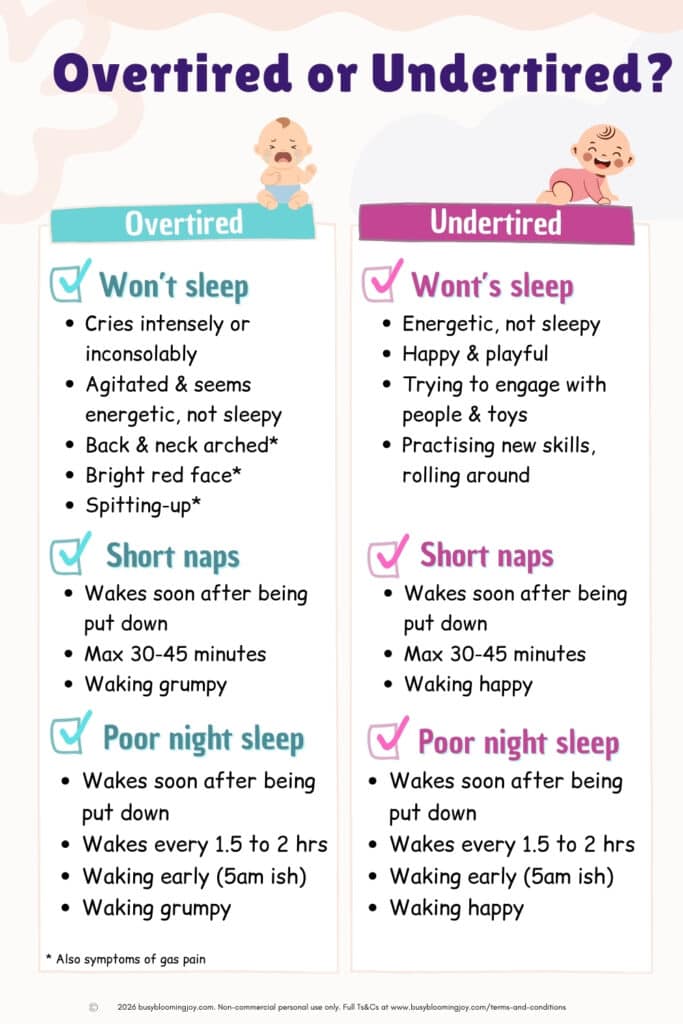
The key difference?
An overtired baby is overwhelmed in their fight to sleep. And will likely wake grumpy.
An undertired baby looks content and not ready to sleep. And will wake early and happy!
Most dramatic bedtime battles are overtiredness — not undertiredness.
And the fix isn’t pushing through. It’s adjusting naps and sleeps in the day.
The Science Behind Overtiredness
If you’ve ever wondered why an exhausted baby doesn’t just crash into deep sleep, the answer lies in two hormones:
Melatonin and cortisol
Melatonin helps induce sleep. It’s inhibited by light so as darkness falls, melatonin levels rise, helping us to wind down, make us sleepy and want to fall asleep.
Cortisol is the ‘stress hormone’, the main driver of the fight-or-flight response.
During a normal day, cortisol rises gradually. By evening, melatonin should take over. When we fall asleep, cortisol drops — and the longer we sleep, the lower it falls. That’s what makes sleep restorative.
But when a baby stays awake too long, the body switches gears.
Instead of winding down, cortisol floods the system to keep them alert.
Unfortunately, this is what makes it so hard to console and calm your baby; she will appear to fight sleep because her body is doing exactly that and will look wired, instead of sleepy.
Cortisol also disrupts sleep
Elevated cortisol continues to disturb sleep throughout the night.
Newborn sleep contains a lot of light sleep, which makes babies extremely sensitive to this hormonal surge.
So an overtired baby doesn’t just struggle to fall asleep.
They:
- Take short naps
- Wake frequently overnight
- Wake early in the morning
And that’s what keeps the spiral going.
So What Does This Mean For You
If overtiredness is a cortisol problem, prevention becomes much clearer.
You’re not trying to “make” your baby sleep.
You’re trying to stop cortisol from escalating in the first place — and give it time to drop.
And that’s where the practical steps come in.
Step 1: Protect Wake Windows
This is the single biggest game-changer.
Most overtired spirals begin with a wake window that’s simply too long.
Sometimes only by 10-15 minutes.
That doesn’t sound like much — but for a small baby, that can be the difference between drifting off calmly and fighting sleep hard.
Learning age-appropriate awake times gives you a framework. Not rigidity — just rhythm.
And if there’s one wake window to protect fiercely, it’s the first one of the day. When that goes well, the whole day should flow better.
Think of wake windows as guardrails that help to keep you out of the spiral.
Figuring Out Your Baby’s Wake Windows
There’s a small window when your baby is tired and will settle easily — if you catch it.
Miss it, and things can unravel fast.
One minute they’re calm.
The next they’re in full overtired meltdown mode.
Your job is to figure out how long your baby can comfortably stay awake before that shift happens.
Those are your baby’s awake times or, more simply, wake times.
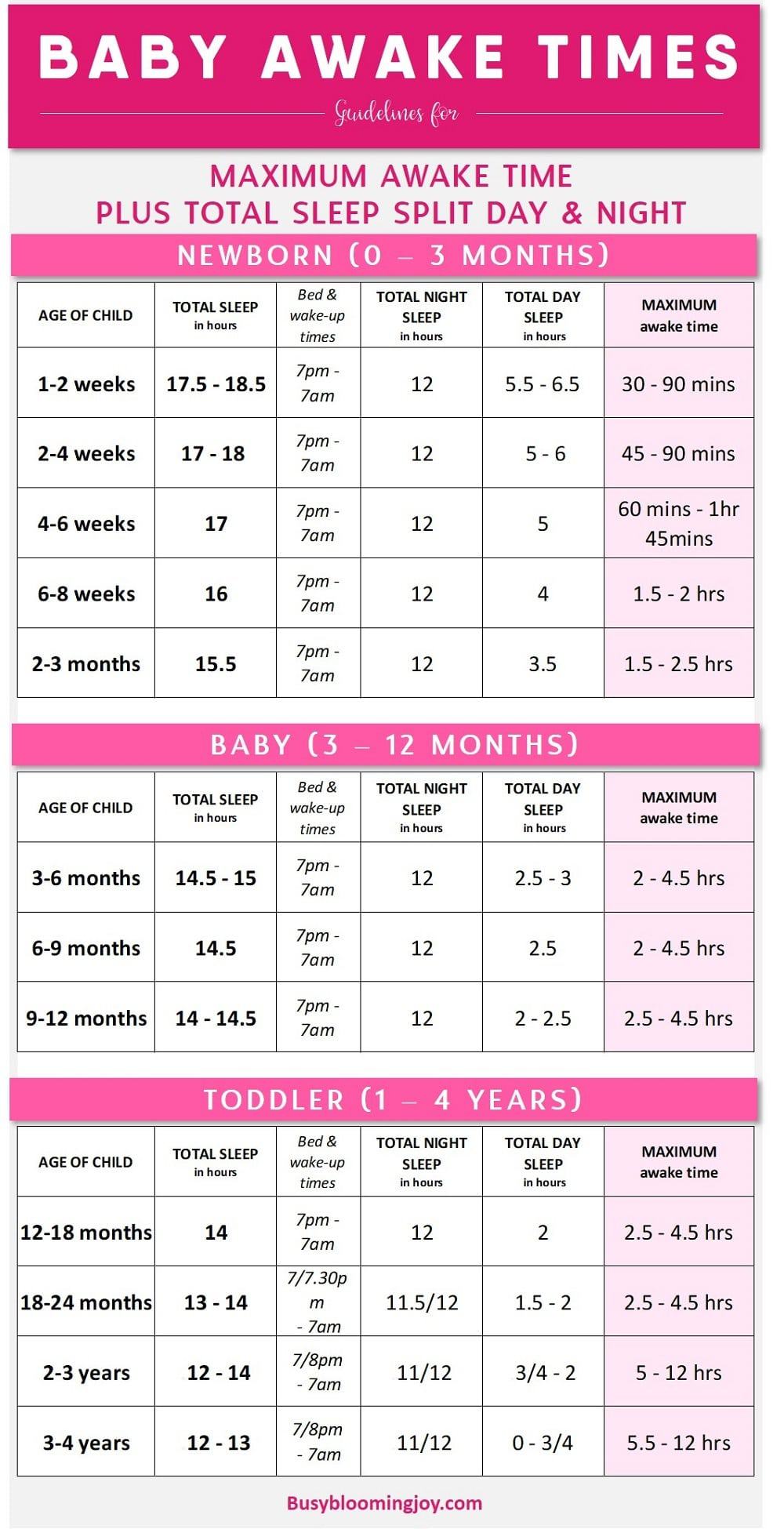
How Long Should Baby Stay Awake?
A tiny newborn may only manage 45 minutes — and that includes feeding time (which can take most of the wake window).
As baby grows, wake windows stretch.
By around 6 weeks, many babies can manage roughly 60–90 minutes.
But here’s the key:
Use wake windows as a guide, not a rulebook.
All babies are different. And even your own baby may vary from one wake period to the next.
E.g. this can depend on:
- How well or long they slept the nap before
- How well they slept the previous night
- Stimulation levels
- Growth spurts
- Developmental leaps
However — if your baby is regularly staying awake far beyond typical ranges (e.g. 4–5 hours as a newborn), overtiredness is very likely at play.
Just because a baby can stay awake doesn’t mean they should.
Don’t be sucked into the cycle of overtiredness
Learn Your Baby’s Early Cues For Tiredness
Wake windows give you structure but sleep cues give you precision.
Some cues are obvious:
- Yawning
- Rubbing eyes (in older babies)
Others are subtle:
- Avoiding eye contact
- Staring vacantly
- Moving jerkily
- Clenching fists
- Becoming very still
Older babies may:
- Turn away from stimulation
- Lose interest in toys
- Become clingy
- Suck fingers
Toddlers often show tiredness differently:
- Lose patience quickly
- Fuss over small things
- Become over-excited or aggressive
- Struggle with normal routines
The key is catching the early signs — not the meltdown.

Listen For The “Sleepy” Cry
There’s often a low-level “I’m tired” sound before things escalate.
We’re not talking about full-blown crying, we’re talking about subtle protest sounds.
Priscilla Dunstan, known for identifying newborn cry patterns, describes the “owh” sound as a tired cue.
The key is to learn your baby’s unique cues so you can respond before cortisol rises and overtiredness takes hold.
Because once you’re in full meltdown territory, you’re firefighting.
The goal is to act while things are still calm.
Learning how to decode your baby’s cries is useful for a lot of other reasons too. Wondering whether you have a gassy baby on your hands or if hunger is the issue? With any luck, your baby will be telling you.
Act Within The Window
Spotting the cues is one thing.
Acting on them is another!
If we’re honest, it’s often us parents who ignore the signs.
I’ve seen the glazed eyes, heard the sleepy sounds and known we were at the edge of the wake window.
And done… nothing!
That tiny slither of opportunity disappears fast.
Calm baby → overtired baby.
In. A. Flash.
Every Baby Is Different
Some babies have a generous window.
My son could yawn for 20 minutes and still settle easily. Even now, he can go from high energy, blazing down the corridors to asleep in 30 minutes flat.
My daughter? Completely different.
If we missed her window by minutes, we were in trouble. Her awake times were critical. Once cortisol kicked in, calming her felt almost impossible and the “witching hour” was almost a given. (She also struggled with reflux and dairy issues… it really wasn’t easy!)

Don’t Wait Until It’s Too Late
Once you spot early sleepy cues, it’s time to move.
Don’t wait for crying.
Don’t squeeze in one more activity.
Don’t hope they’ll push through.
Once cortisol rises, you’re no longer settling a tired baby.
You’re calming a stressed one.
Practical Ways To Avoid Missing The Window
Even when you know what to look for, life gets busy.
Here’s how to stay ahead of overtiredness:
1. Keep Track Of The Time
Keeping track of time is one of the simplest ways to prevent cortisol from spiking.
Use an app if it helps.
Guessing rarely works when you’re sleep-deprived!
Wake windows aren’t about rigidity — they’re about awareness.
2. Encourage Naps On The Go (If You Need To)
Real life doesn’t stop because your baby needs to nap.
And while naps on the go won’t be as good, that sleep will still go a long way in getting baby some rest and rebooting cortisol levels.
If nap time is nearing and you are out, do your best to create a sleep-inducing environment:
- In the buggy: pull the hood down to reduce light and stimulation
- In the carrier: turn baby inward to block visual distractions
- At someone’s house: step into a quieter space and mimic your wind-down routine
The goal is simple: reduce stimulation before cortisol climbs too high. Provide a calm, relaxing environment with minimal lighting and help baby settle to sleep.
Step 2: Guard Total Daily Sleep
Protecting wake windows is only half the equation. Total sleep matters too.
A baby who never stays awake too long but doesn’t clock enough overall sleep will still build sleep debt — and that leads straight back to overtiredness.
Check How Much Sleep Baby Is Getting
There’s no exact magic number. Just like wake windows vary, total sleep needs vary too.
But there are healthy ranges.
Check the baby awake times chart above for total daily sleep guidelines. (More on baby sleep needs here.)
If your baby consistently sleeping far below those ranges, overtiredness is likely an issue.
Look at the whole picture:
- Daytime naps
- Night sleep
- How settled baby seems
- How often they’re waking
If sleep totals are significantly low, cortisol doesn’t get the chance to drop properly — and the spiral continues.
What If Baby Is Sleeping More?
If your baby is sleeping well and waking mainly to feed overnight, more sleep is usually a good thing.
Rested babies are happier babies!

However, if baby is sleeping excessively during the day and then wide awake at night, day–night confusion may be the issue — and that’s a separate rhythm problem to solve.
The Big Picture
You don’t need to obsess over every minute, simply zoom out occasionally and ask:
Is my baby getting enough total sleep across 24 hours?
Because a well-rested baby:
- Settles more easily
- Naps longer
- Wakes less
- Smiles more
Enough sleep keeps cortisol from building up in the first place.
And that’s what stops the overtired spiral from tightening.
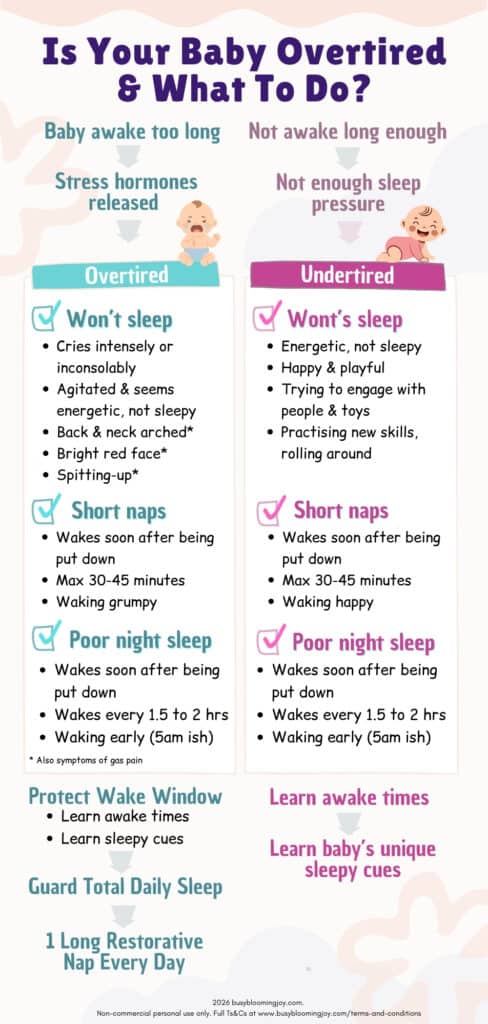
Step 3: Encourage A Long, Restorative Nap
If cortisol rises with wakefulness, it drops with sleep.
So the longer baby sleeps, the further it falls.
That’s why naps that stretch beyond one 40–45 minute sleep cycle are so powerful.
A nap that runs into a second cycle — ideally 1.5 to 2+ hours — gives the body a real chance to reset.
While short naps can take the edge off, long naps restore.
For this reason, this newborn sleep and feeding schedule is based around a long 2-2.5 hour nap in the middle of the day.
Why Super-Short Naps Don’t Cut It
Naps under 30 minutes are rarely restorative.
If baby doesn’t reach deeper sleep, cortisol doesn’t drop much at all. They wake still tired — and often fussier.
Think of how you feel after fragmented sleep versus one solid stretch.
Babies are no different.
One longer nap in the day can completely change:
- Mood
- Evening behaviour
- Bedtime resistance
- Night wakings
It’s a genuine game-changer.
How To Encourage Longer Naps
Long naps start with acting within the wake window — that’s your foundation.
But if naps are consistently short, three common factors are usually involved:
1. Something Is Disturbing Baby Between Sleep Cycles
Babies transition between sleep cycles roughly every 40–50 minutes.
Common disruptors include:
- Startle reflex or ‘Moro Reflex’ → swaddling (if age-appropriate) can help
- Light → aim for a very dark room
- Noise → use consistent white noise
- Temperature → ensure baby isn’t too hot or cold
- Hunger → consider a small top-up feed before the nap

And sometimes the biggest disruptor?
Rushing in too quickly.
Babies are noisy sleepers. A short ‘pause’ before intervening can give them space to resettle. (More on newborn sleep here)
2. Baby Can’t Link Sleep Cycles Independently
Newborns sometimes need time to mature into this.
Older babies (around 4+ months) may rely heavily on whatever helped them fall asleep at the start of the nap.
When that support disappears between cycles, they wake fully.
Encouraging calmer, more independent settling (gradually and gently) often supports longer naps over time.
This doesn’t mean abandoning your baby.
It means giving them the chance to practise settling when well-rested — not overtired.
3. Baby Isn’t Quite Tired Enough
This is less common in an overtired spiral — but if wake windows are too short, baby may wake after one cycle because sleep pressure wasn’t high enough.
That’s why rhythm matters.
The Big Picture
You don’t need every nap to be two hours.
But aiming for at least one solid, multi-cycle nap most days helps:
- Lower cortisol
- Protect bedtime
- Improve night sleep
- Improve mood (for both of you!)
Long naps are so much more than convenience, they’re restorative.
And when cortisol drops properly during the day, the entire overtired spiral begins to loosen.
More on encouraging a magical 2+ hour nap here.
Breaking The Overtired Cycle
Is your baby:
- Showing tired cues all day but still fighting sleep?
- Waking cranky and seeming exhausted?
- Sleeping hours less than typical recommendations?
If so, cortisol is likely disrupting sleep.
High cortisol = poor sleep:
- short naps
- disturbed nights
- early morning wakings
Poor sleep = sleep debt
Sleep debt = cortisol leaves don’t reset
It’s a vicious circle.
How To Reset An Overtired Baby
If you’re already stuck in the cycle of overtiredness, prevention takes a back seat to recovery.
Your goal is simple:
Reduce sleep debt > Lower cortisol > Improve sleep > Reduce sleep debt
That means stepping in to help your baby fall asleep. And help them resettle when they wake.
For now, don’t worry about sleep props.
Clearing sleep debt comes first.
Once baby is better rested, everything will become easier. Then you can gradually reducing extra support if needed.
Make Sleep The Priority
Focus on:
- Longer naps where possible
- Earlier bedtimes
- Reducing stimulation
- Protecting wake windows
Sleep really does beget sleep.
The more sleep baby gets, the easier sleep becomes.
Pre-sleep wind-down routines and a more structured nap and bedtime routine can also help limit overtiredness and support calmer settling.
When Wake Windows Can Change
Even when you’ve cracked it, things change.
Babies love to shift the goalposts!
Suddenly the wake window that worked perfectly… doesn’t.
Here are common triggers that increase tiredness:
- Too many naps on the go
- Several short naps in a row
- Illness or teething disrupting night sleep
- Growth spurts
- Developmental leaps (rolling, crawling, standing)
And try not to judge one day in isolation.
A poor nap day can affect the next. Expect slightly shorter wake windows and a little more support if needed.
Stay flexible. Watch cues. Adjust gently!

In Summary
If your baby always seems to be fighting sleep, you’re not imagining it — and you’re not alone.
Now you know:
- Why overtired babies keep waking
- How cortisol drives the spiral
- How to prevent it
- And how to break it when you’re already in it
Protect wake windows.
Watch early cues.
Guard total sleep.
Prioritise restorative naps.
When your baby is well-rested, everything will become easier!
You got this!
__________________________________
Enjoyed this post? Any questions? Any weird and wonderful things you’ve tried to get your overtired baby to sleep? Let me know in the comments!
Other posts you may find helpful if you are, or are about to become, a first time mom:
- 24 Game-Changing Newborn Hacks For First-Time Parents
- Newborns first bath: how to sponge bathe a newborn with umbilical cord still attached
- How to tub bathe a newborn step-by-step
- How to help a newborn poop instantly!
- How to get your newborn to sleep in a bassinet instead of your arms
- 37 easy tips to help your newborn adjust to the world
- 25 best ideas on how to organize baby’s closet, to keep it neat and looking cute