

You’ve made it through the earliest days, and now your little one is starting to wake up to the world — literally. At 3 to 6 weeks old, your newborn is a tiny bit more alert, feeding is (hopefully!) getting more predictable, and you might be wondering… is it too early for a routine?
Not at all.
While newborns thrive on flexibility, following a gentle daily rhythm can help your baby eat better, sleep more soundly, and reduce overtiredness and fussiness. It can also give you a bit more confidence and calm in your day — and that’s priceless!
In this post, I’ll walk you through a simple and flexible daily routine along with “what to expect” at this age and some pointers to help you navigate this age.
This is not a rigid newborn schedule! Just a way to guide you through the day – that supports the development of healthy sleep habits with a simple rhythm that works.

What To Expect From 3 to 6 Weeks
- Less daytime sleep & longer awake times
- Baby eats every 2-3 hours
- A growth spurt at around 6 weeks
- Colic and The Witching Hour
LESS SLEEP NEEDED, LONGER AWAKE TIMES
As your newborn grows and develops, the time they’re content to stay awake between naps should increase. At the same time, daily sleep needs will decrease – so less daytime sleep will be needed.
FEEDS EVERY 2-3 HOURS
By 6 weeks, your newborn should be content to eat every 3 hours (3 hours being from the start of one feed to the start of the next).
A GROWTH SPURT AT AROUND 6 WEEKS
Similar to the 3-week one, this will last around 3 days. Your baby might feed more often, seem extra clingy or fussy, and/or need a bit more sleep than usual.

COLIC AND/OR THE WITCHING HOUR
Colic is long, apparently unexplained bouts of crying (often for hours), while the “Witching Hour” is an evening surge of fussiness. Both are most common between 3–6 weeks.
Gas, overtiredness, and overstimulation are normally major triggers: Trapped wind, insufficient burping and poor latching can be a factor in both.
And by late afternoon, tiredness and overstimulation can make babies fuss and cry excessively.
These posts discuss all of these in more detail:
- 16 Common causes & remedies for your gassy baby
- Colic: what is it & is crying really inconsolable?
- 3 tactics to prevent overtiredness that really work
CLICK THIS LINK TO DOWNLOAD THIS PDF FOR FREE
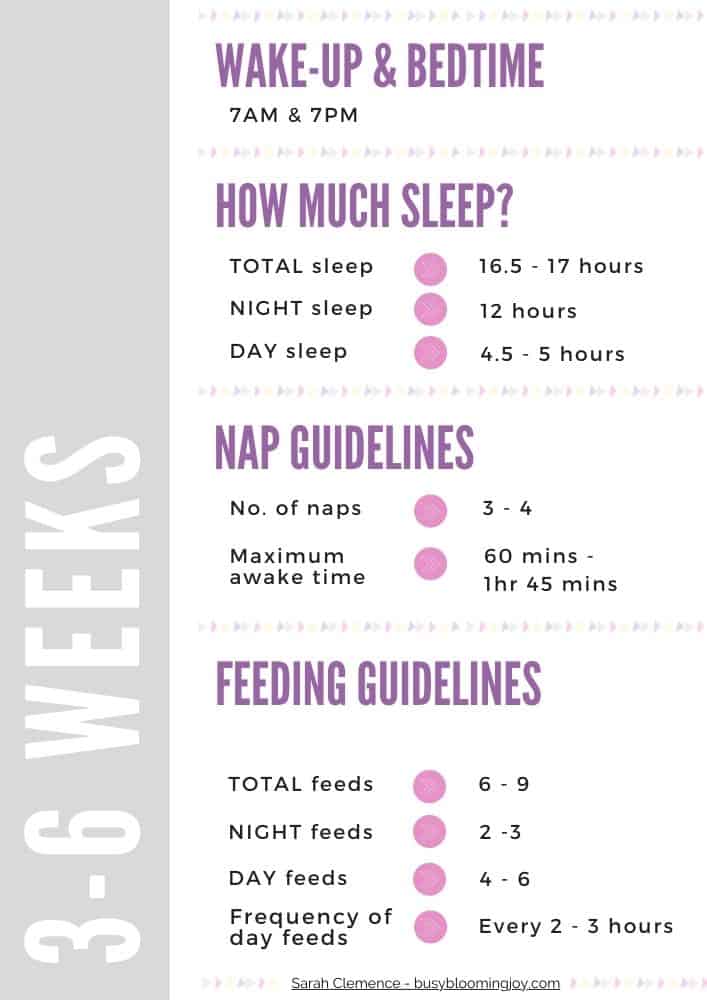
Sleep & Feeding Expectations 3 to 6 Weeks
Daily sleep needs
- Total sleep: 16.5 to 17 hours
- Night sleep (e.g. 7 pm to 7 am): 12 hours
- Day sleep (e.g. 7 am to 7 pm): 4.5 to 5 hours
Nap guidelines
- No. of naps in the day: 3 to 4
- Awake time (including time spent feeding): 1 hr to 1 hr 45 minutes
Daily feeding guidelines
- Total feeds: 6 to 9
- Night feeds: 2 to 3
- Day feeds: 4 to 6
Frequency of feeds: every 2 to 3 hours
Your Daily Newborn Schedule for 3 to 6 Weeks
Now that your newborn is able to stay awake a decent amount of time, a good period of activity/playing should be possible in addition to eating.
This active/awake period should be after your baby has eaten, rather than before. On waking, your newborn will eat more efficiently having just woken up, so more likely to take a good, “full” feed.
This also helps prevent baby from falling asleep while eating (a sleep prop that you may want to avoid.)
This cycle supports the development of healthy sleep habits – gentle baby sleep training strategies for newborns.
CLICK THIS LINK TO DOWNLOAD THIS PDF FOR FREE
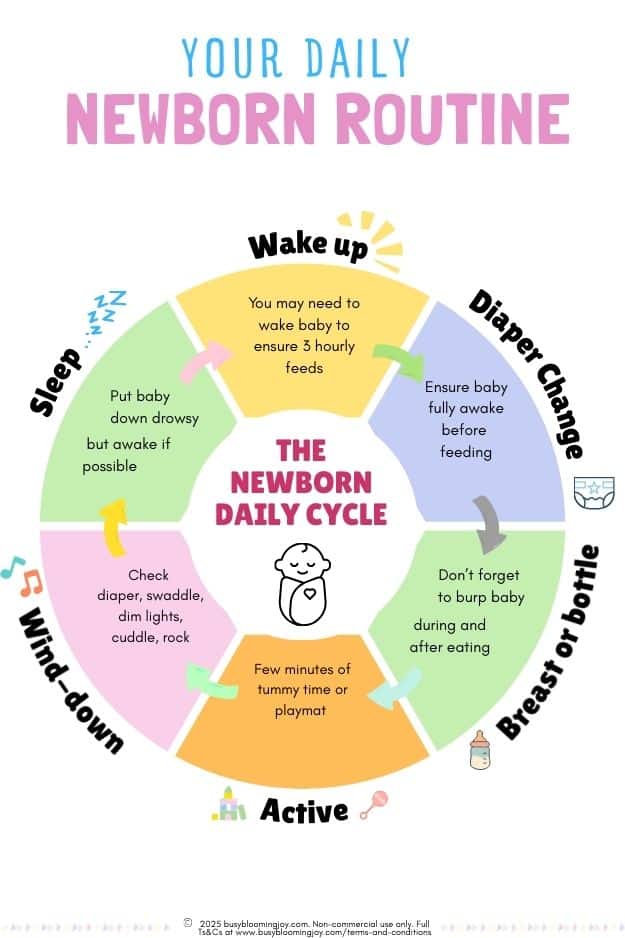
One Routine Cycle
The cycle is milk → awake time → sleep → milk which repeats through the day. At night, the cycle should simply milk → sleep → milk → sleep!
In more detail, the daily newborn schedule for 3 to 6 weeks involves the following steps.
1. Wake up
Your baby wakes naturally from a nap — or you gently wake your baby if it’s time for a feed. You can do this:
- turn lights on or open curtains
- unswaddle baby
- pick baby up, talk to her
- lie her on her playmat and let her stretch/kick about etc
2. Diaper change
A quick diaper change helps your baby fully wake up and helps your baby get ready for an efficient and active feed.
3. Milk
Offer a full breast or bottle feed, stopping to burp at least once during the feed as well as afterwards. (Check out these baby burping tips if you need.)
4. Awake & active time
After feeding, try some tummy time, simple sensory play and so on.
5. Wind-down
Quick diaper check before settling baby back to sleep. I’d recommend swaddling your baby, moving into calm environment, dim the lights and put on some white noise or lullabies.
6. And sleep
Lay baby down drowsy but awake, if possible, or gently rock to sleep if needed.
And Repeat
The cycle repeats every 2–3 hours.
As your baby grows and develops, the cycles should naturally become longer in time, so feeds are a little less frequent. E.g. feeding every 2 hours at around 3 weeks, stretching to every 3 hours at 6 weeks.
Naps may also increase in length, but be careful not to let your baby sleep too much in the day! 4.5 to 5 hours of sleep between the hours of 7 am and 7 pm.
If your baby is waking at night and not settling quickly back to sleep after eating, and is well burped and otherwise comfortable, then they’re probably sleeping too much in the day or may have days and nights confused. Learn how to reverse day night confusion here.

Example Daily Routine With Timings
These times are based on your 3 to 6 week old feeding every 2.5 to 3 hours, with the first feed of the day at 7 am. Remember, to treat this schedule as a guide only!
Cycle 1:
- 6.45 am – start to wake (draw curtains, remove swaddle etc)
- 6.55 am – diaper change (ensure baby is full awake)
- 7 am – milk
- 7.45 am – awake & active
- 8.15 am – wind-down
- 8.30 am – sleep
Cycle 2:
- 9.15 am – start to wake (draw curtains, remove swaddle etc)
- 9.25 am – diaper change (ensure baby is full awake)
- 9.30 am – milk
- 10.15 am – awake & active
- 11 am – wind-down
- 11.15 am – sleep
Cycle 3:
- 12.15 am – start to wake (draw curtains, remove swaddle etc)
- 12.25 am – diaper change (ensure baby is full awake)
- 12.30 pm – milk
- 1.15 pm – awake & active
- 1.45 pm – wind-down
- 2 pm – sleep
Cycle 4:
- 2.45 pm – start to wake (draw curtains, remove swaddle etc)
- 2.55 am – diaper change (ensure baby is full awake)
- 3 pm – milk
- 3.45 pm – awake & active
- 4.15 pm – wind-down
- 4.30 pm – sleep
Cycle 5:
- 5.15 pm – start to wake (draw curtains, remove swaddle etc)
- 5.25 am – diaper change (ensure baby is full awake)
- 5.30 pm – milk
- 6.15 pm – awake & active
- 6.30 am – bedtime routine with bath
- 7 pm – sleep
For a more structured routine that encourages one longer 2 hour nap (a complete game changer!) head to this newborn sleep and feeding schedule here.
What To Focus On
First, check out these recommendations for 0-3 week olds
These are shared in the 0-3 week daily newborn routine post so skip over if you need.
If you’re not doing so already, be sure to:
- swaddle your baby – this both helps to calm your newborn and prevent the Moro reflex from disturbing or waking baby up (learn how to swaddle here.)
- burp your baby frequently, both before and during a feed (loads of tips on the best ways to burp a newborn here)
- set up baby’s sleep zone so that it’s pitch black (use blackout blinds or curtains) and use a white noise machine to both calm your newborn and eliminate any possible disturbances. This will help baby sleep undisturbed, aiding long stretches of sleep. (Check out tip no. 7 in this newborn baby tips post.)
- Learn the “baby cues” unique to your newborn, which will help you understand if they need to eat, have gas and need to burp and so one.
- Learn some calming techniques: try the colic carry or the “jello head jiggle” as explained in this calming baby post).
- Feed on demand, aiming for “full” feeds – wake sleepy feeders and, if nursing, let baby finish one breast before switching to the other so they reach the fattier and more satiating “hind milk”
- Wake baby in the day if necessary, in order to feed at least every 3 hours (as long as birth weight has been regained. You want to maxmise day feeds in order to minimise night feeds.
- Don’t keep baby awake too long – avoid overtiredness. At 3 weeks old, your baby may only be able to stay awake an hour, stretching to a max of 1 hour 45 mins the max.
Recommendations for a 3 to 6 week old baby
In addition to the above, try the following:

CLICK THIS LINK TO DOWNLOAD THIS PDF FOR FREE
- Start the day at a reasonable time – this is the time your baby will have her first feed of the day. You will need to wake baby if necessary! I’ve always done 7 am, meaning that bedtime is roughly 12 hours later, ie at 7 pm. But could do 8 am until 8 pm or whatever suits you.
- Start a bedtime wind-down routine – add a bath, massage or something else into your wind down routine that is calming and relaxing.
- Start a “Dream Feed” – last feed before you go to bed around 9.30/10pm or 2.5-3 hours after your baby’s bedtime. (Learn how to Dream feed here.)
- If colic or the Witching hour – try to get to the bottom of these, try the following:
What’s next?
If you want to progress to a more structured schedule with fixed feeding and nap times, and your baby is now feeding every 3 hours check out the ultimate newborn feed and sleep schedule, with age by stage guides. (All strategies are gentle sleep training baby tips.)
Or look out for a daily newborn schedule for 6 to 12 week olds, coming soon!
All set with baby tips? Take a peek at these nursery ideas next:
- 49 Out of this World Space-Themed Nursery Ideas for Your Little One
- 30 Gorgeous Easy Nursery Painting Ideas for Baby Boys, Girls & Toddlers
- 41 Stunning Rainbow Nursery Ideas for Baby Boys & Girls
- 75 Green baby nursery ideas: sage to olive, dark to light
- 49 Out of this World Space-Themed Nursery Ideas for Your Little One