

The first few weeks with your newborn are a total blur, right? Time loses all meaning, you’re operating on three hours of broken sleep (if that), and you’re googling, , “is this normal?” at 2 a.m. with one hand while rocking a baby with the other.
The truth? So much of what you’re experiencing is in all liklihood normal — but it still helps to have a guide.
This post walks you through what to expect from birth to 3 weeks and shares practical and actionable newborn baby tips to help you navigate those early days and weeks.
Whether you’re a new mom, have another tot by your side already or are still expecting, these baby hacks will set you up for success with your little one and gently begin to establish healthy sleep habits. (Yes, even this early on!)
From cluster feeding and swaddling to waking a sleepy baby for a feed (yes, you should!), here’s everything you need to know to get through the fog of the newborn phase — with a little more calm and a lot more confidence.
Let’s dive in.

What to Expect From Birth to 2 Weeks
Lots of Sleepiness!
Your newborn will sleep a lot in those early days and weeks — around 18 or more hours a day — waking mostly just to feed. Your baby may only have a few brief “awake” moments in between feeds.
Take advantage of this sleepy phase — rest, eat, and recharge while you can. It won’t last long!
Your Milk Coming In
This normally happens between days 2 and 5. Continue to feed your baby often and on demand to help your body produce the milk your little one needs.
Baby Wanting to Eat Constantly
It’s completely normal for your newborn to seem permanently hungry in those early days. This frequent or “cluster” feeding is how your baby helps establish your milk supply.
It can be exhausting (and yes, you’ll be starving and parched too!), but it’s temporary — and it’s a sign that things are working just as they should. Hang in there!
Newborn Baby Tips For Birth to 2/3 Weeks
1. FEED ON DEMAND – FREQUENTLY!
Getting feeding established is the no. 1 focus in the first few days and weeks. This is hardwork, particularly if breastfeeding.
Establishing breastfeeding means building your milk supply quickly to meet your baby’s needs. Because milk is produced on a supply and demand basis, this means feeding frequently and on demand – whenever your baby wants.
Even if you’re formula feeding, feed on demand.
Regardless of how you’re feeding, feed at least every 3 hours (this means if your baby ate at 7am, the next feed is due to start no later than 10am.)
Read more about feeding on demand here.

2. WAKE BABY TO FEED IF NECESSARY
If baby is sleeping and it’s been 3 hours since the last feed, wake that baby up! Ignore those who say “you can’t wake a sleeping baby”.
You need to carry on with those 3 hourly feeds day and night until baby’s birth weight has been regained.
Once regained, you must keep up with 3 hourly feeds in the day but let baby sleep longer at night.
3. IF BREASTFEEDING, WORK ON GETTING A GOOD LATCH
This is essential for successful breastfeeding, both so that baby can feed efficiently and to ensure you stay comfortable and don’t get sore nipples.
Trying different nursing positions can help.
Read about how to get a good latch here.
4. IF BOTTLE FEEDING, TRY TO MINIMISE GASSINESS
Bottle feeding may make your baby gassy, but there are steps you can take to minimise the extra air they take in when eating.
Here are a few ways to help reduce swallowed air and keep gas at bay:
- Let the formula settle: After shaking, allow the bottle to sit for a few minutes so bubbles can disperse before feeding.
- Always fill the teat with milk: Hold the bottle at an angle that keeps the nipple fully filled — this prevents baby from sucking in air.
- Use anti-colic bottles: Try bottles designed to reduce air intake. I used the Dr Brown’s Options+ bottles for their venting system, which is helps to minimise gas.
- Ensure you’re using the right teat:
- Too slow → baby gets frustrated, sucks hard, swallows more air.
- Too fast → baby gulps, chokes, or dribbles milk.
Watch how your baby feeds and adjust the teat size if needed.

5. LEARN HOW TO BURP YOUR BABY
Newborn babies swallow a lot of gas when eating (and crying), so it’s really important to pause at least once during a feed and allow them to burp.
Sometimes all you need to do is to sit your baby upright, but sometimes this may not be enough. In which case, you need to experiment with positions that put firm pressure on the lower abdomen, just below the ribcage. This helps to expel gas up and out.
The sitting position shown in the photo above works well. With your newborn sitting on your lap, tip your baby forwards, while you support their head and neck, to create that firm pressure on the lower abdomen.
You’ll find more burping positions and tips in this hard-to-burp baby post.

6. LEARN HOW TO SWADDLE!
Swaddling can make a huge difference in helping your baby settle and sleep more soundly:
- It calms the startle or “Moro” reflex – the jerky, involuntary movement that all newborns are born with, that can jolt them awake. A snug swaddle helps prevent those little limbs from flailing and waking your baby.
- It mimics the womb. The gentle pressure of a swaddle recreates the cozy, contained environment your baby was used to before birth. That caccooning effect can be incredibly soothing.
- It helps babies sleep longer. Without constant interruptions from startles or limb movement, babies are more likely to stay asleep (and therefore so are you!).
- It creates a clear sleep cue. Over time, swaddling becomes a strong association with sleep, signalling: “it’s time to wind down.”
Mastering a good swaddle can feel tricky at first (some babies are mini escape artists), but once you get the hang of it, it can truly be a sanity-saver in those early weeks and months.
To learn 3 simple and effective swaddles, sign up to our free swaddle course. There are step-by-step video tutorials and printables so you’ll be a swaddle pro in no time,
NB: remember that for safe sleep, you must place baby on her back to sleep.
7. SET UP BABY’S SLEEP ZONE FOR GREAT SLEEP
As soon as your newborn is a little more alert (at around 2 weeks), you want to ensure the place they sleep in is free from disturbance. So set it up beforehand – ideally you’d do this when preparing for baby, but if not, now is the time.
So, for great sleep (i.e. as long a stretch of sleep as possible) ensure:
- sleep zone is pitch black – there are plenty of blackout curtains and blind options here.
- sleep zone has white noise or another dull and consistent background noise (I used and loved the Hatch Baby Rest Sound Machine it has plenty of sounds to chose from).
Tips For Moms From Birth to 2 Weeks
8. GET AS MUCH REST AS POSSIBLE
Easier said than done, but whether you gave birth naturally or by C-section, both are major ordeals for your body (and your mind!) and you need time to recover. Sleep whenever you can, hand baby over if and when you can, and rest or sleep.
9. EAT HEALTHILY, DRINK A LOT (NOT ALCOHOL!)
Feed your body for recovery and to fuel your boobs if you’re breastfeeding. If you’re breastfeeding, you’re going to need to drink a lot of extra water. Keep a bottle of water or juice with you at all times and try to drink a decent-sized glass or two after every nursing session.

9. LOOK AFTER YOUR NIPPLES, IF BREASTFEEDING
Lanolin-based nipple cream (affiliate link) is essential to both prevent and treat cracked nipples. The key is to put it on frequently (at least after every breastfeed) before any cracking even starts, because prevention is way, way better than cure.
10. DON’T BE AFRAID TO ASK FOR HELP
Whether it’s with breastfeeding, concerns with your baby, lack of sleep or with your frame of mind, there is absolutely no harm in seeking help.
11. GO EASY ON YOURSELF!
Another easier-said-than-done one, but you may have high expecatations of being a mom and of your own abilities to “get it right”. Lots of it might not come naturally very quickly (it didn’t for me). Give yourself grace and give yourself time.
What to Expect 2 to 3 Weeks
A Bit More Wakefulness
During the first two weeks, your baby likely snoozed most of the day — waking mainly for feeds, then drifting right back to sleep. But around the two-week mark, your little one will start to become more alert between feeds.
This is exciting — but it also means:
- You may start to see signs of day-night confusion (i.e. baby wants to party at 3 a.m. but barely opens her eyes during the day).
- Baby may now become easily overstimulated, so keeping things calm and watching for tired signs becomes really important.

Birthweight Regained
By weeks 2 to 3, your baby should have regained (and even passed) her birthweight. This is a great sign that feeding is going well and things are on track.
That First Growth Spurt
Around the 3-week mark, get ready for your baby’s first major growth spurt. It can last anywhere from 3 to 7 days.
Expect extra feeding, fussiness, and maybe more clinginess — all totally normal. Some babies also sleep more during a growth spurt… but wake more frequently, too. The changes might be subtle, but they’re part of this big early leap!
Newborn Baby Tips From 2 to 3 Weeks
12. GET BABY “FULL” AT EVERY FEED
Now that baby is a tiny bit more awake, you should be able to work at getting bigger feeds each time, so that she is “full”. You don’t want a serial snacker on your hands – a few sips here, then a few sips there shortly after.
Try to encourage these full feeds so that you get a decent interval between each one, and not feeding more than every 2 hours.
(2 hours is the time from the start of 1 feed to the start of the next e.g. if you start feeding at 9am, finish at 9.30, then start the next feed at 11am, that’s a 2 hour interval.)
If your baby is getting tired and sleepy: it’s very important to wake your sleepy feeder! This goes for night feeds too; you want your baby to have eaten enough to be able to sleep a decent stretch.
If you’re breastfeeding, it’s also important to switch breasts only when the one you’re nursing from is empty. This ensures baby reaches the fattier “hindmilk”, helping to keep her fuller for longer.

13. WAKE BABY TO FEED IN THE DAY
As long as your newborn has regained her birth weight you no longer need to stick with 3 hourly feeds at night, but you DO need to continue this in the day.
As tempting as it is to let baby sleep past feed times in the day, don’t!
You want to maximise the amount your baby eats in the day, which means feeding every 3 hours. Otherwise, in order to fulfil their daily calorific needs, your newborn will be catching up at night.
14. GET THOSE BABY CUES NAILED
You may have found baby so sleepy in the first 2 weeks there was minimal fussiness and crying and feeding was all that your little one required. So now that she’s a little more awake, there might be a little more action, i.e. body, arm and face movements as well as sounds or cries.
Learning the “baby cues” specific to your newborn will ensure you can respond appropriately. For example, a little scrunching of the face and wriggling lower down combined with the “eh” sound normally indicates baby needs to burp.
According to Priscilla Dunstan 5 distinct cries or ‘words’ as follows:
- Neh = “I’m hungry”
- Eh = “I need to burp”
- Eair = “I have lower gas pain”
- Heh = “I’m experiencing discomfort” (Check diaper)
- Owh = “I’m sleepy”
You can listen to these different cries here:
In this baby cue post you’ll find more out about all the different body movements that may accompany those cries.
Now is the time to turn into your baby and try to understand their language! It’ll take a while, but with time and patience and plenty of observation you’ll better at understanding whether your baby is hungry, tired, gassy and so on.
15. REVERSE ANY DAY NIGHT CONFUSION
With exposure to daylight and the natural business of day time activity, day night confusion will naturally disappear. But it could take several weeks. With a little bit of work, you can help this reversal and it should only take a few days.
The general idea is to work on day feeds being light and bright and encourage short spells of wakefulness afterwards, and keep night feeds dull and boring.
This is also where those 3 hourly feeds in the day come into play; catching up on milk requirements at night will only add to day night confusion.
Read all about the nitty-gritty of reversing day-night confusion here.

16. AVOID OVERTIREDNESS
True or false:
The longer you keep baby awake the better they will sleep.
Nope! In fact, the opposite is normally true.
The hormonal response to excessive stimulation or being awake too long makes it hard for babies to fall asleep; settling an overtired baby is an exhausting battle you may not win.
At 2-3 weeks old, your newborn can probably only stay awake just over an hour before needing to sleep.
(Because all babies are different, the “awake time” for this age is 45 to 90 minutes, as indicated in the printable below.)
If 45 minutes of that time is spent eating (which could very well be the case if you’re working on getting baby full) that doesn’t leave much time for anything else.
If baby is awake for a full 90 minutes at one point in the day, it’s likely that at the next feed, she will need a much shorter awake time.
The key here is to watch out for signs of tiredness, “sleepy cues”, and put baby down to sleep before overtiredness enters the room. (Listen out for “owh” when it comes to cries/sounds and look for other sleepy cues).

17. START A WIND-DOWN ROUTINE
This should help calm and relax your baby and get her ready for sleep. In addition, it’ll start to set the stage for sleep: in time it’ll teach your baby that sleep is the natural end to this routine.
At just 2-3 weeks the wind-down routine needs to be short and sweet and repeatable and as simple as:
- taking baby to her sleep space
- dimming the lights
- checking and changing diaper if necessary
- swaddle
- sway, rock or cuddle (all the way to sleep if necessary)
- put white noise on, baby in her cot, switch off lights and leave
If a gentle sway, rock or cuddle isn’t enough to settle your newborn, the next baby tip will help!
18. LEARN HOW TO INITIATE THE CALMING REFLEX
However well you burp your baby, however hard you look out for cues your baby needs to sleep or eat or go to a quiet place, there will be times when everything goes out the window! You’ll get it completely wrong. Or for whatever reason, you simply won’t be able to do whatever it is your baby needs….
And in a short space of time, your newborn is completely inconsolable and your usual tricks to settle and soothe just won’t cut it.
Learning Dr Karp’s 5 S’s to initiate the “calming reflex” is going to be a game changer. It uses a very specific movement called the “jello o’head jiggle”. You guessed it, you’re going to make your baby jiggle like jello!
Full details on Dr Karp’s 5 S’s method here.
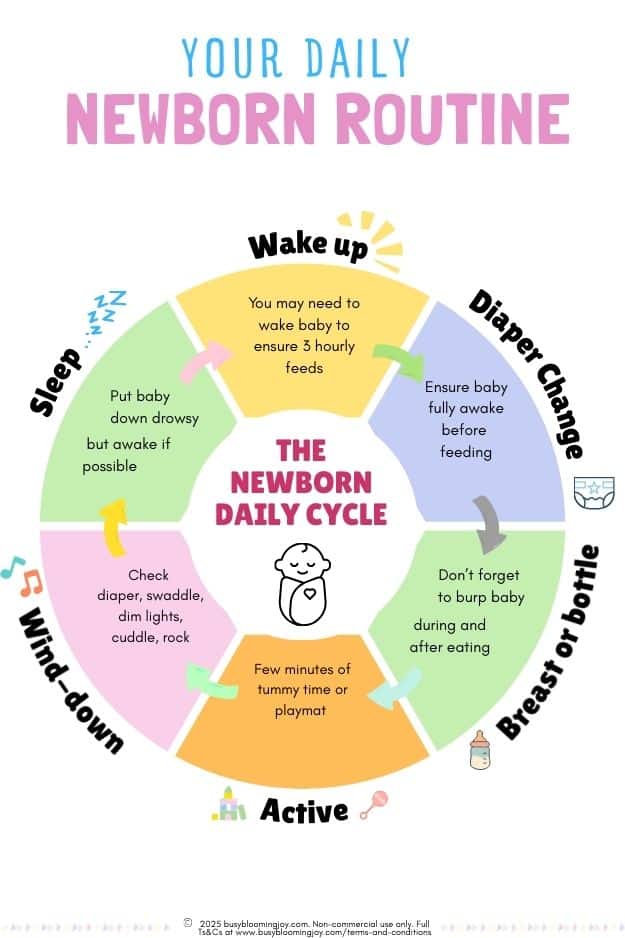
CLICK THIS LINK TO DOWNLOAD THIS PDF FOR FREE
19. FOLLOW THE CYCLE OF: MILK → AWAKE → SLEEP
This simple routine sets up better feeding and sleep habits from the start:
- Feeds are more effective when baby is fully awake after a nap — leading to fuller tummies and longer stretches between feeds.
- Separating feeding from sleep helps prevent baby relying on milk to fall asleep every time.
Here’s this cycle in detail:
- Wake up
Let baby wake naturally or gently rouse her (unswaddle, lay on playmat etc).
2. Nappy change
Change diaper to help baby fully wake; try a quick “top-and-tail” with a warm cloth if still sleepy.
3. Milk
Feed while baby is most alert for a fuller feed; pause to burp during and after.
4. Awake time
Keep it short — 5–10 minutes maybe plenty. Try gentle newborn play, tummy time, or cuddles.
5. Wind-down
Do a quick nappy check, swaddle, dim the lights, turn on white noise, and cuddle.
6. Back to sleep
Settle baby, ideally drowsy but still awake.
Once you’ve found your feet, you may want to try a more structured routine with your baby. Learn how to start a schedule with your newborn here.
20. NAVIGATING THE 3 WEEK GROWTH SPURT
Just when you thought you were getting into some kind of rhythm, bam! The first major growth spurt. Don’t panic…
Just keep feeding on demand, but expect baby to eat for longer at each session and/or more frequently. It will take a few days for your body to respond to your baby’s increased appetite.
If you feel your body is struggling to keep up with your baby’s needs, be patient if you can – it will eventually.
Avoid topping up with formula as without the nursing stimulation, your body simply will never be able to produce the required milk. This is a fast track to stopping breastfeeding altogether, so if you want to carry on, bare with it…
In the meantime, make sure you’re eating plenty of healthy snacks and keeping well-hydrated. Rest when you can.
Your baby may also need a little more sleep, so watch out for those sleepy cues early and put baby down before overtiredness hits.
What To Expect From 3 to 6 Weeks
- Less daytime sleep & longer awake times
- Baby eats every 2-3 hours
- A growth spurt at around 6 weeks
- Colic and the witching hour
Less sleep needed, longer awake times
As your newborn grows and develops, the time they’re content to stay awake between naps should increase. At the same time, daily sleep needs will decrease – so less daytime sleep will be needed.
Feeds every 2 to 3 hours
By 6 weeks, your newborn should be content to eat every 3 hours (3 hours being from the start of one feed to the start of the next).
A growth spurt at around 6 weeks
Similar to the 3-week one, this will last around 3 days. Your baby might feed more often, seem extra clingy or fussy, and/or need a bit more sleep than usual.

Colic and/or the witching hour
Colic is long, apparently unexplained bouts of crying (often for hours), while the “witching hour” is an evening surge of fussiness. Both are most common between 3–6 weeks.
Gas, overtiredness, and overstimulation are normally major triggers: Trapped wind, insufficient burping and poor latching can be a factor in both.
And by late afternoon, tiredness and overstimulation can make babies fuss and cry excessively.
These posts discuss all of these in more detail:
- 16 Common causes & remedies for your gassy baby
- Colic: what is it & is crying really inconsolable?
- 3 tactics to prevent overtiredness that really work
Newborn Baby Tips For 3 to 6 Week Olds
Hopefully, you’re a little more clued up on your baby’s cues and have eliminated any day night confusion. If not, those are things to continue to figure out.
Continue to:
- Get baby “full” at every feed
- Wake baby in the day to stick to 3 hourly feeds
- Watch awake times and look out for sleepy cues to avoid overtiredness

21. START THE DAY AT A REASONABLE TIME
As much as it’s tempting to sleep until nearly lunchtime after a rough night, as soon as you can muster the energy, figure out what time you want to “start the day”. This is the time your baby will have her first feed of the day.
Bedtime is roughly 12 hours after you start the day.
Choose a wake-up time somewhere between 6 am and 8 am, which will make bedtime somewhere between 6 pm and 8 pm. These timings work towards the natural circadian rhythm that your baby will develop.

22. START A BEDTIME WIND-DOWN ROUTINE
This is just a longer version of your wind-down, with the most common addition, a bath. It’s absolutely not essential to bath baby everyday – some just don’t like baths or they love bathing so much it can rev them up, rather than help wind them down.
(Try these tips for bath time, including for babies that don’t like to bath.)
Whatever you add to the wind-down, needs to be something that calms and relaxes. It’s also something you can consistently do nearly every day.
Jump to the full lesson here: Bedtime wind-down (& bath time tips)

23. START A “DREAM FEED”
A “dream feed”, is the first night feed, at around 9.30/10pm or 2.5-3 hours after your baby’s bedtime.
For this night feed, you wake baby, feed, pop back into her cot and then jump into bed yourself and sleep. It should mean you get a good few hours before baby wakes for the next feed.
In the first couple of weeks, when baby is likely to wake every 2-3 hours anyway, the nightcap has no relevance: if baby fed at 6 pm then she’s likely to wake before 10pm anyway..
But at 4-5 weeks, your newborn should be able to start to manage one longer stretch of sleep; you want this to be when you’re asleep.
It can be rather easier said than done so check out this post which will teach you how to Dream feed for success.
25. IF COLIC OR THE WITCHING HOUR CROP UP…
First port of call, is to ensure overtiredness isn’t an issue (check awake times) and make sure you are burping your baby sufficiently.
(Although the overtiredness is the obvious factor in the witching hour due to the time of day, accumulated trapped wind due to insufficient burping throughout the day can also contribute.)
Next is to check any other reasons for excessive gas which might be causing the colic or witching hour.
You’ve Got This, Mama
The First 6 Weeks: You’re Finding Your Way
These early weeks can feel like a rollercoaster — full of snuggles, surprises, and more than a few sleepless nights. But every cry soothed, feed given, and moment of calm you carve out is a step forward.
Whether you’re learning how to swaddle, figuring out those baby cues, or battline the witching hour, remember: you’re doing it. Your baby doesn’t need perfection — just you, showing up with love, day (and night) after day.
So take these tips as gentle guidance, not a rigid rulebook. Trust your instincts, ask for help when you need it, and above all — be kind to yourself.
You’ve got this, one newborn day at a time.
______________________________
For more posts to support you through the newborn phase, try these: