

If you’re reading this, you probably haven’t slept properly in days. Maybe weeks!
You’re not alone — and it doesn’t have to stay this way.
I’ve had four very different babies, plus countless sleepless nights and a borderline obsessive amount of reading!
But with this simple framework, gradually things started to change — and sleep, glorious sleep, became a reality.
In this post I will reveal all…
My firstborn was a serial snacker.
Feeding every 20 minutes. Waking 7, 8, 9 times a night. By week three I was running on fumes and starting to lose my mind.
My second had viral meningitis at 3 weeks old. A spitter-upper of note. An absolutely terrible start to life outside the womb.
By the time babies three and four arrived — twins — I had a little bit of a clue. I was already working with the framework.
But the reality of two babies at once was quite quite something…
One half the weight of the other at birth. Constantly hungry. Playing catch-up to her bigger brother at every single feed.
Two babies. Simultaneously. Every feed, every wind-down, every 3am waking — times two.
And it still worked!
When My Babies Started Sleeping All Night
My first two were sleeping through by 11 and 12 weeks respectively.
Despite the initial snacking all day and all night for my firstborn. And the terrible spitting up and discomfort from my second.
The twins were slightly later.
Bigger brother sleeping through by 5 months — or 4 months adjusted to his due date.
His sister, the tiny catch-up baby: 6 months. She had more ground to cover.
This simple 3-part framework worked each time, it’s just each baby had their own timeline.
Which makes a good point: this isn’t a rigid schedule. It’s a set of principles that meets your baby where she is.
No cry-it-out. Just gentle sleep training strategies applied consistently.
Even with twins. Even with a tiny baby playing catch-up from day one.
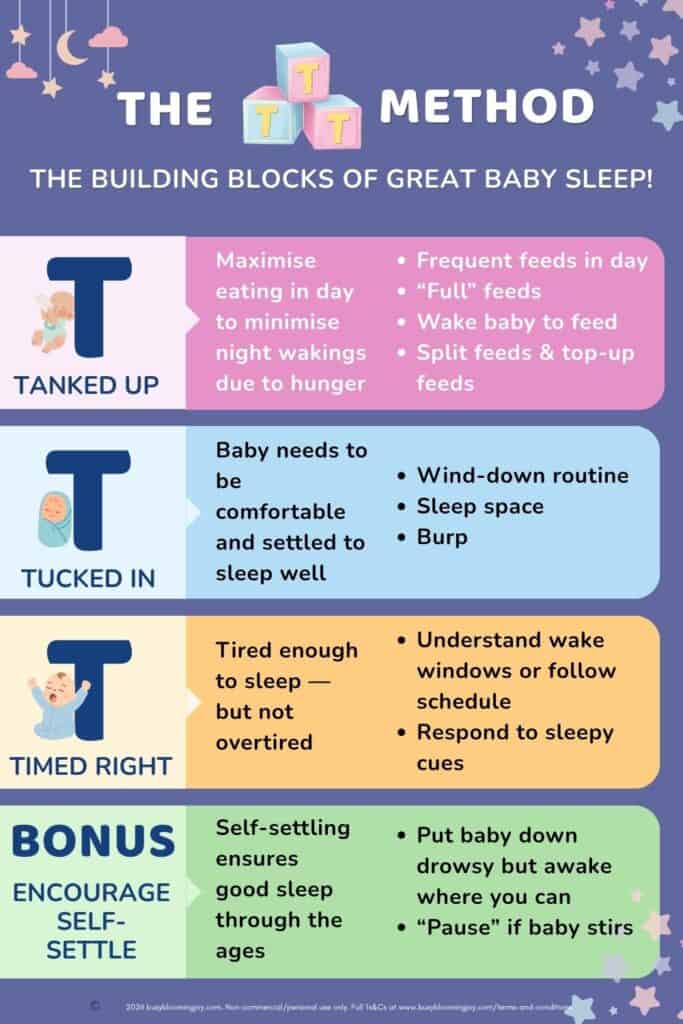
Part 1: Tanked Up
To be happy to fall asleep and then stay asleep for long periods baby needs to be “tanked-up” on milk.
This means feeding baby “on demand” or whenever hunger strikes by responding promptly to baby’s hunger cues.
Ideally you want your newborn to eat every 2-3 hours in the day. More often and you may have a “serial snacker” on your hands. (My firstborn…)
A few minutes of milk, falls asleep, wakes 20 minutes later, feeds again. Day and night. On repeat.
A serial snacker will never be properly full and won’t be able to do long stretches of sleep, either day or night.
It is important to feed on demand. But it’s also important to make sure these feeds are adequate enough that the demand isn’t too frequent!
Less frequently than every 3 hours and your baby will almost certainly be waking frequently to eat – babies have small tummies so need to eat frequently.
The goal is a full feed, every 2-3 hours so baby has enough fuel to sleep a proper stretch.
Tips to get baby “Tanked Up” in the day:
1 – Encourage “full feeds”
Keep baby awake during feeds — tickle the feet, blow on the face, undress if needed. Do whatever you can for your newborn to take a bigger feeder – this can take several weeks!
You also want to respond to early hunger cues — a frantic, crying baby gulps air gets gassy easily and is likely to tire before full
2. Follow a simple routine of milk, awake and active, then sleep
This means baby feeds when most awake and alert.
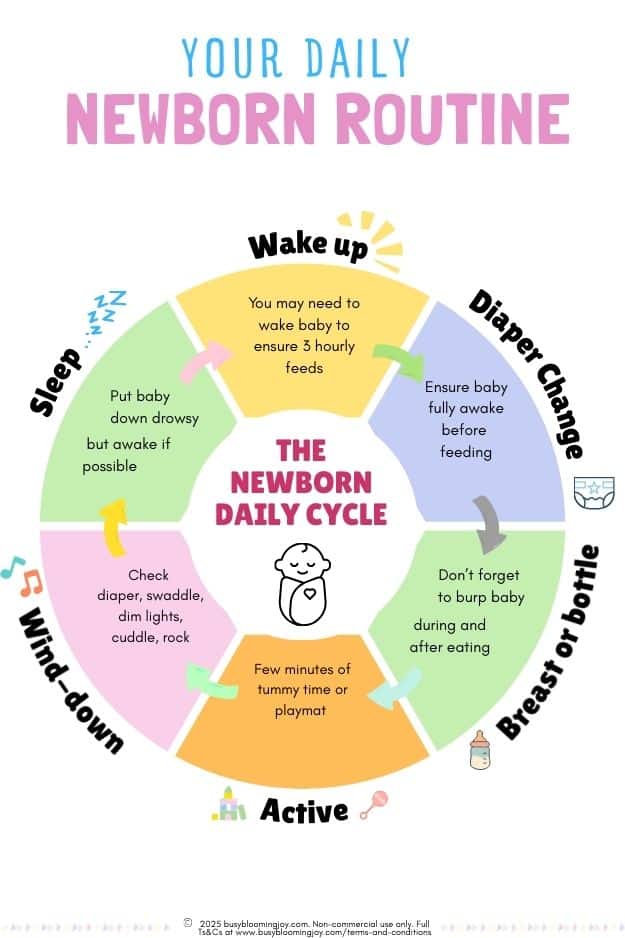
For more detail on the chart above, check out the daily newborn routine post.
3. Make sure baby eats at least every 3 hours in the day
Snacking isn’t great, but the other extreme is that your baby doesn’t feed enough in the day.
You want to MAXIMIZE daytime feeds in order to MINIMIZE those at night.
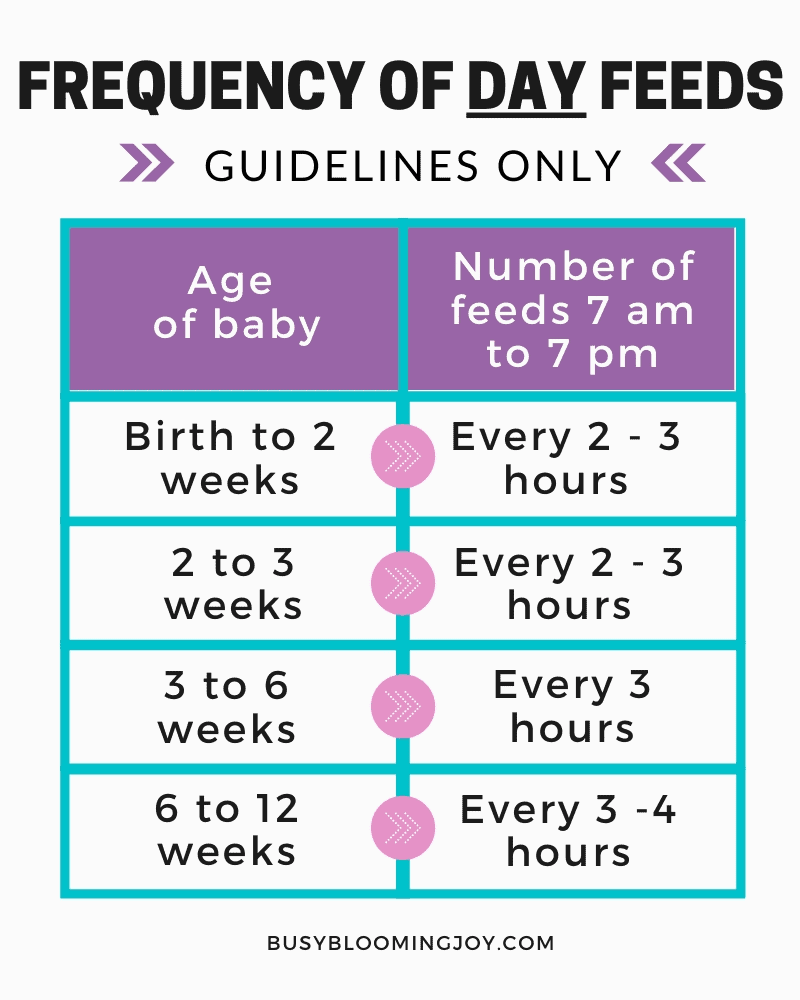
The latest advice is to breastfeed your newborn AT LEAST every 3 hours until birth weight has been regained
*3 hours is the time from the start of one feed to the start of the next. So if baby took 1 hour to feed, then a feed will be due 2 hours later.
This may means waking baby to feed in the day! (Yes, you can wake a sleeping baby – it’s very necessary for this specific reason.)
3. If breastfeeding, switch breasts once the first is completely empty
The fattier hindmilk at the end is what keeps baby fuller for longer
A well-fed baby sleeps, a snacking baby doesn’t.
Part 2: “Tucked In”
Coming out of the womb is a hell of a shock.
Think about what your baby just left behind.
Pitch dark. Vacuum-cleaner loud. Tightly coiled, with firm pressure all around.
Consistently warm and constantly rocked every time you moved, breathed, walked or rolled over in bed.
For nine months!
Then: bright lights. Cold air. Varying degrees of noise. No pressure. No movement. No rhythm.
Not forgetting annoying gas bubbles due to an immature digestive system…
Your baby will not sleep well if she’s too hot, cold, has a dirty diaper, has trapped wind, has gas pains, is disturbed by a loud noise or bright lights, or is fractious or uncomfortable in about 101 different ways!
Your baby needs to be comfortable and snug and Tucked In just right!
Is it any wonder that newborns wake up?!
Tips to get baby “Tucked In”
1. Create a Magic Sleep Zone
This is key to your baby feeling settled and comfortable — meaning sleep comes easily.
It recreates the womb as closely as possible. Three things are non-negotiable.
- Pitch black — not dim. Not a soft nightlight. Properly pitch black. Even a thin line of morning light at 5am will cause early waking. Blackout blinds or curtains are not optional!
- White noise — your body sounds like a vacuum cleaner from the inside. Silence is unfamiliar and unsettling for a newborn. A white noise machine or app, running all night, mimics the womb and masks the sounds that would otherwise startle baby awake.

- A firm swaddle — baby had constant pressure all around her in the womb. The Moro or startle reflex means arms will flail around at any sudden sound or movement. It can wake your baby every time unless her arms are contained. A firm swaddle suppresses the reflex. When your baby starts showing signs of rolling, move to a sleeping bag.
These three things alone, consistently in place for every sleep, whether day or night, will make a noticeable difference almost immediately.
But there’s one last one:
2. Burp Baby Both During And After Each Feed
There’s no hard and fast rule for exactly how much to burp your baby, but it’s probably a lot more than you think.
If your baby:
- brings up a lot milk (spit-up) after a feed
- is tense in the face
- wriggles and squirms
- flails arms and legs
- looks generally uncomfortable & irritable
- struggles to fall asleep or stay asleep
Trapped wind could well be the issue and burping more would be a good start!

My second born was particularly gassy for various reasons and I eventually learnt that 10+ burps per feed is the absolute minimum I had to aim for.
I owe this knowledge to Philippa Murphy, a postnatal educator, author, mom and founder of BabyCues. She spent 6 years caring for newborn babies, living in with families for months at a time and also studied the digestive biology of infants at length. She knows her stuff!
Get as many burps out as possible during and after a feed to avoid pain and discomfort from trapped wind
To effectively burp your baby you want to put firm pressure on the lower abdomen. You can then rub baby’s back with your other hand.
For all the tips and advice you could possibly need, check out this post on how to burp your baby.
3. Have A Wind-down Period Before Sleep
Winding down is the shortish time before a nap or sleep time that will help (over time, when repeated) tell baby that it’s time to sleep.
You want to create a routine that’s:
- repeatable – carry out the same routine every time
- not too long – 15 to 45 minutes depending on baby’s age
- calm and relaxed
Try this:
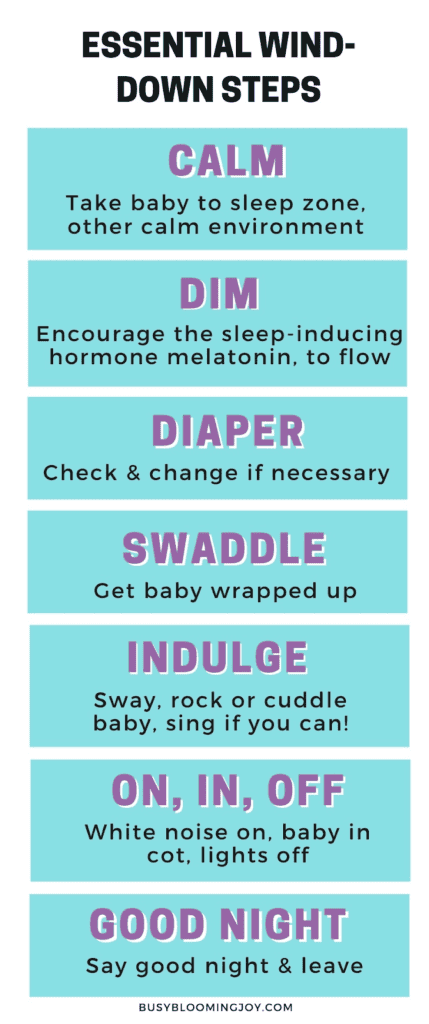
If you struggle to settle baby, try the Dr Karp’s 5S’s – no. 1 technique for calming a crying baby.
Part 3: Timed Right
The tired thing is kind of obvious… baby is not going to want to fall asleep or stay asleep if she’s not very tired.
Your baby needs a little bit of time (dependent on age) to be active and build up sleep pressure.
In those first few days and weeks all this time may be taken up by eating! As your baby grows, they’ll be able to stay awake longer – enough for a little play and socialisation.
But keeping your baby awake too long in the hope they’ll sleep better and settle quicker will almost always backfire.
Babies will fight sleep if they’ve stayed awake too long.

An overtired baby is flooded with cortisol – the stress hormone that keeps us alert and awake.
It’s a physiological response. And it makes settling feel like wrestling an angry octopus!
Which means an overtired baby is highly likely to only take short naps and wake up multiple times at night… Oh, and early in the morning (cue the 5 am waking).
The goal is to catch the sleepy window: tired enough to sleep, but not yet overtired.
Miss it by 15 minutes and you can spend an hour trying to settle your baby!
Tips to get it “Timed Right”
1 – Learn Your baby’s unique wake windows
This is the window when your baby is tired and will settle easily — if you catch it.
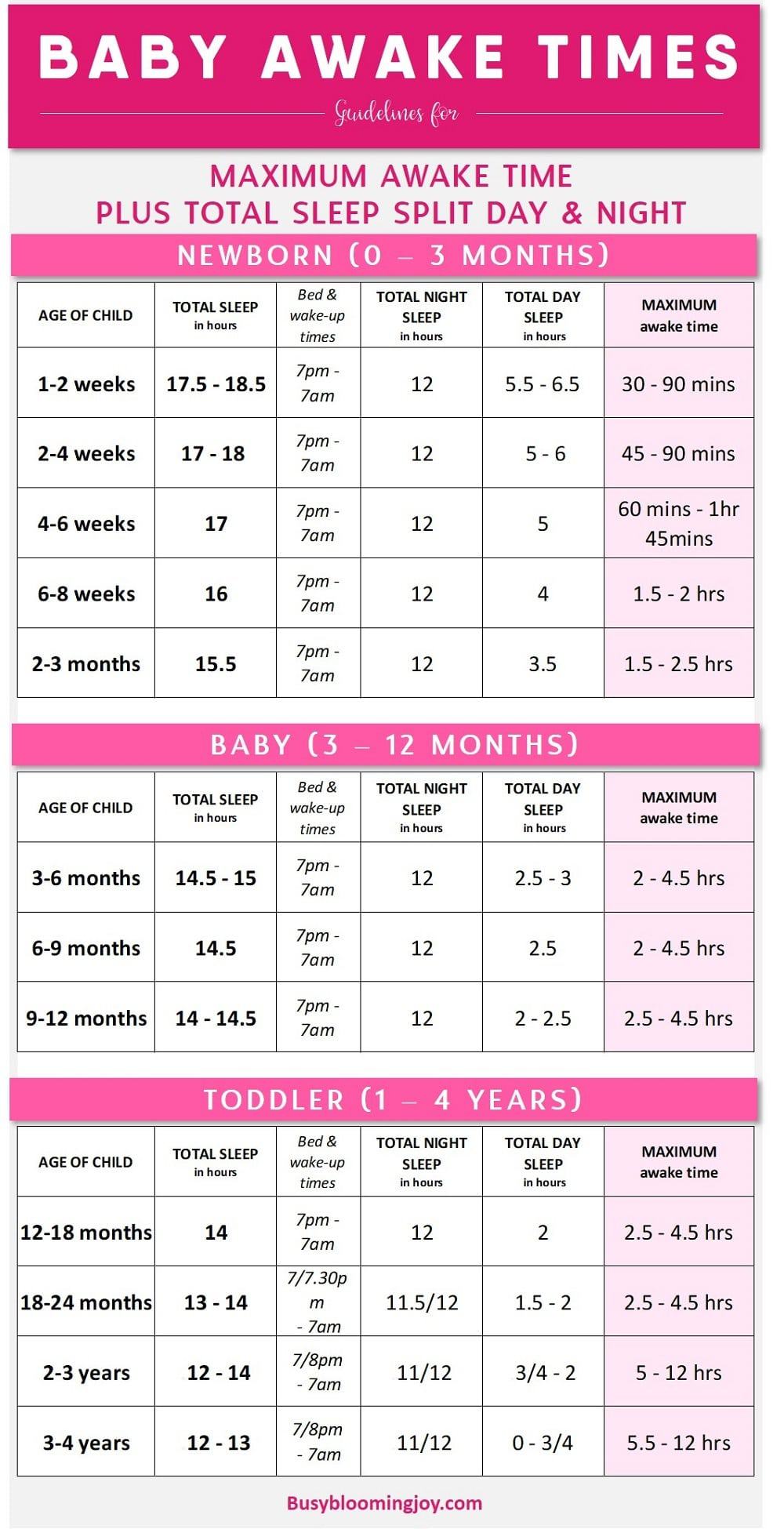
Use this chart as a guideline, then combine it with your knowledge of your baby’s sleepy cues.
Some cues are obvious:
- Yawning
- Rubbing eyes (in older babies)
Others are subtle:
- Avoiding eye contact
- Staring vacantly
- Moving jerkily
- Clenching fists
- Becoming very still
Older babies may:
Suck fingers
Catch the early signs and act on them!
Remove your baby from stimulation, take them to their magical sleep zone and start your wind-down routine.
2 – Guard Total Daily Sleep
Total sleep i.e. day and night combined also matters.
And just like wake windows vary, total sleep needs vary by baby too.
But there are guidelines for typical healthy ranges.
Scroll up a bit and check the baby awake times chart above for total daily sleep guidelines – first column. (More on baby sleep needs here.)
If your baby consistently sleeps less than suggested, overtiredness could well be an issue.
More detail on overtiredness and how to avoid it here.

The bonus: self-settling
Get Parts 1, 2 and 3 right and you will have a much more settled, much better sleeping baby.
But there’s one more piece that makes the difference between a baby who sleeps well and one who will continue to sleep well, or with little change, during developmental leaps, teething, illness and so on.
Self-settling.
You may have heard of the term and asociate it with cry it out sleep training.
But fear not! If you set the stage right – i.e. tank baby up, tuck them in and time it right – chances are your baby will drift off to sleep.
So all you actually need to do is allow your baby the chance to fall sleep without your assistance.
If you’re able to do this, when sleep matures at around 3-4 months when brief full wakings become common, there’s a good chance your baby will fall back to sleep without your help.
This is key to your baby sleeping through the night consistently through the baby and toddler years!
Does it actually work?
My firstborn, the serial snacker, the 9-times-a-night waker, was sleeping through by 12 weeks.
My daughter, the reflux baby, the meningitis survivor, the spitter-upper – she took a little while longer but still, sleeping through at 4 months is not so bad!
And then the twins…
So yes, this framework absolutely does work!
Not because I got lucky. Because I was consistent.
Unfortunately there’s no silver bullet or magic overnight fix.
There will be crap nights.
Write those nights off. Start fresh the next morning. Keep going!
The framework works. You just have to work it.
You got this! Any questions, let me know in the comments.
____________________________
If you’re looking for more tips and tricks to navigate the baby stages, try these:
- 25 Newborn Baby Tips For The First 6 Weeks
- How to help a newborn poop instantly!
- How to sponge bathe a newborn baby with umbilical cord still attached
- What should a newborn baby wear to sleep in bed at night?
- What’s better: A swaddle vs sleep sack for a newborn?
- When is it Safe to Travel with a Newborn Baby by Car or Plane?
- 24 Game-Changing Newborn Hacks For First-Time Parents