

You’ve made it to three months — and things are about to get a lot more exciting.
Your baby is more alert, more interactive, and that gorgeous little personality is really starting to shine through.
And here’s the really good news: sleeping through the night is within reach!
My first two (breastfed) babies were sleeping through by 12 weeks following this exact schedule – the twins weren’t that far behind.
With the right routine in place at three months, you’re closer than you think.
In this post I’ll share everything you need to know about sleep at three months — wake windows, nap times, total sleep needs — plus a sample 3 month old sleep schedule to download and start using today.
Is This The Right Schedule For Your Baby?
This schedule is designed for babies aged around 10–12 weeks — the consolidated end of the newborn phase.
If your baby is closer to 8 weeks and still only managing wake windows of around 1.5 hours, try this 2 month sleep schedule as i’ll likey be a better fit — wake windows are shorter and the day is more generous with sleep.
Signs you’re in the right place:
- Wake windows of around 2 hours feel comfortable
- Your baby settles at naps without becoming overtired too quickly
- Feeds are well established and at least every 3-hours
If all of those feel true — you’re in the right place. Let’s go!
Baby Sleep Needs At 3 Months Old
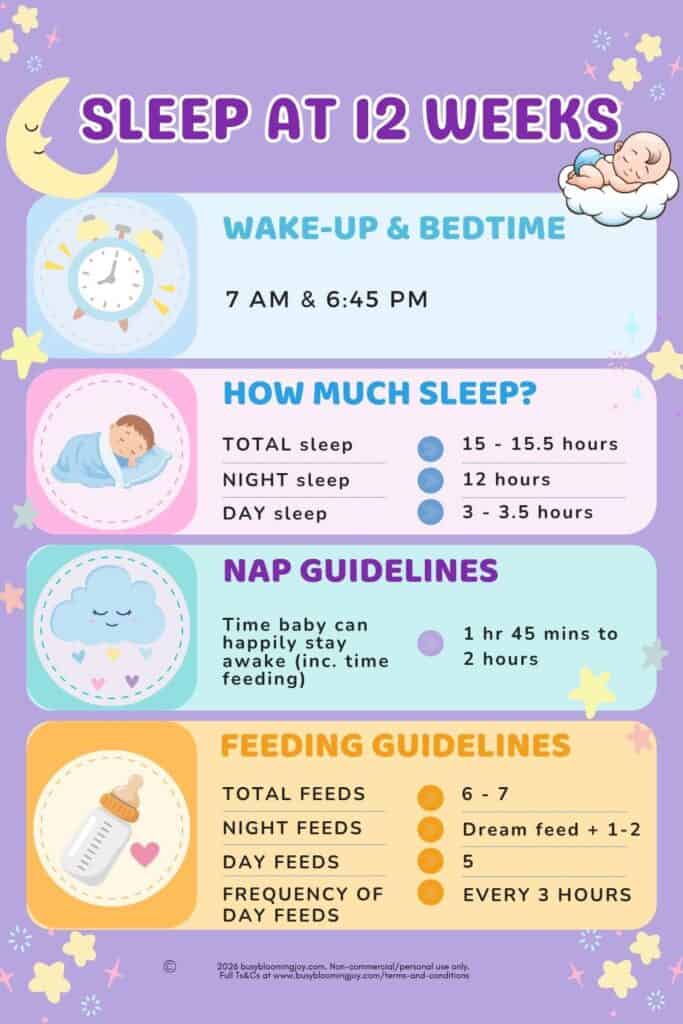
At 3 months, here’s what to expect when it comes to sleep and naps:
Download Sleep at 12 Weeks PDF here
Daily sleep needs
- Total sleep: 14 to 15 hours in a 24 hour period
- Night sleep (e.g. 7 pm to 7 am): 12 hours
- Day sleep (e.g. 7 am to 7 pm): 3.5 hours
For a full breakdown by age, this baby sleep chart is really handy.
Nap guidelines
- No. of naps in the day: 3 (2 short naps and one longer lunchtime nap)
- Awake time (including time spent feeding): Around 1 hr 30 minutes ( Watch those sleepy cues!)
Daily feeding guidelines
- Total feeds: 6 to 7
- Night feeds: Dream feed plus 1 to 2
- Day feeds: 5
Frequency of feeds: every 3 hours
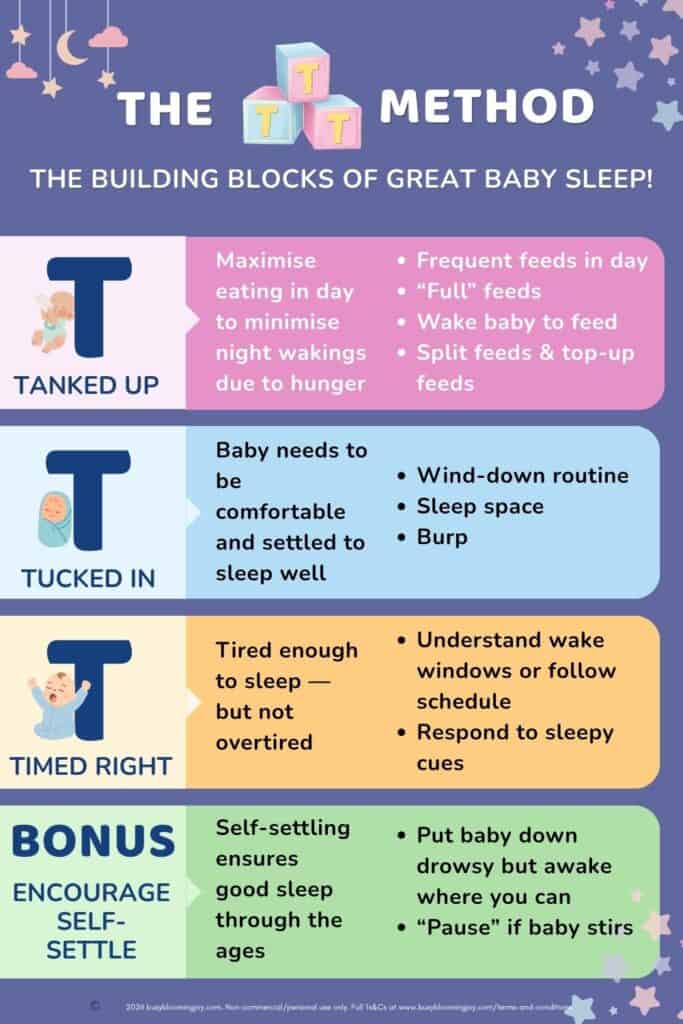
The 3-Part Framework That Makes This Baby Schedule Work
These are the principles that underpin all the baby sleeps schedules here on Busy Blooming Joy.
If you’ve come from the 2 month schedule post, feel free to skip over this part by clicking here.
Part 1: Tanked Up
A well-fed baby sleeps. A snacking baby doesn’t.
You’ll notice the schedule has regular but well-spaced feeds through the day. This is intentional — you want to tank your baby up with milk to minimise night wakes up due to hunger.
Miss a feed, and you’ll almost certainly pay for it at night.

So always wake your baby for the scheduled feeds in the day, even if sleeping soundly.
This can be hard when you’re busy with jobs or just enjoying a little break – I get it! But, here’s the thing:
Any milk missed in the day will be caught up at night.
When you do feed, aim for a full feed. Keep your baby as awake and alert as possible — tickle those feet, blow on her face, take a layer off if you need to. A few sips here and there just won’t cut it.
“Tanked up” also the reason for “split feeds” and “top-up feeds” – explained in detail later.
Part 2: Tucked In
Your baby won’t stay asleep — however well fed and tired she is — if she’s uncomfortable or easily disturbed. There are a few things to nail here, the most important are:
- your baby’s sleep space
- the wind-down
- burping
The sleep space
The aim is to recreate the conditions your baby experienced in the womb – dark, very noisy, firm pressure from all around.
Similar conditions will calm and comfort your baby, help them settle and fall asleep.
In addition, these conditions will minimise external disturbances and help your baby stay asleep.
(Babies are light sleepers and easily disturbed – this is a protective measure.)
So setting up the sleep space is really important, and crucial to establish the long lunchtime nap.
So the sleep space needs to be:
Pitch black. Not dim — properly dark. Blackout blinds are essential. Even a sliver of light or a sudden noise can pull your baby out of sleep between cycles.
Have white noise running throughout every nap — low, rumbly, and loud enough to drown out background sounds.

in addition:
Baby needs to be swaddled – this calms the Moro reflex — the involuntary startle that jolts sleeping babies awake — and recreates the cocooning feeling of the womb.
The wind-down
You’ll see wind-down built into the schedule before every single nap. This isn’t filler — it’s really important.
The same short, calm routine before every sleep, will help relax your baby. So take baby to her sleep space, dim the lights, check the diaper, swaddle, a gentle rock or cuddle with white noise on.
Do this consistently and over time your baby’s brain starts to recognise these cues as “sleep is coming” — making settling quicker and easier every time.
Burping
Always burp well before putting baby down.
Trapped wind is a surprisingly common cause of early wake-ups and disturbed sleep. If your baby is particularly gassy, this post is worth a read.
Here are some tips and techniques for burping your baby,
Part 3: Timed Right
Naps are spaced so that the time your baby is awake is a max of 2 hours. This is to avoid your baby becoming overtired.
An overtired baby is flooded with cortisol, the stress hormone that keeps us alert.
The more overtired your baby gets, the harder she’ll fight sleep, the shorter naps will be, and the number of night wakings may increase too.
You may only miss the window by 20 to 30 minutes but it could take an hour to resettle your baby.
Use the schedule timings as your guide — but always watch your baby too.
Start the wind-down when you see those early sleepy cues — yawning, glazed eyes, turning the head away — even if it’s a little before the schedule says.
Getting baby down before overtiredness hits is really important.
Bonus: putting baby down awake
As sleep cycles begin to mature, between 3 and 4 months, the way your baby falls asleep starts to become important.
Whatever your baby associates with falling asleep — being fed, rocked, held — she’ll need that same thing every time she wakes between cycles.
Now is the time to gently start putting baby down drowsy but awake where you can.
Even once or twice a day makes a difference.
This will really minimise the 4 month sleep regression and future ones. Independent settling is the real key to sleeping through the night consistently.
This 3 month baby sleep schedule will really help with independent settling.
Baby will be Tanked Up, Tucked In and Timed Right. Your baby will be well fed, tired but not overtired, and settled in her sleep space — meaning putting her down drowsy but awake should be possible.
However, you can still follow this sleep schedule without putting baby down awake.
Just be aware that if your baby always needs to be rocked or nursed to sleep, those habits will become hard to break.
The 3 Month Old Baby Sleep Schedule
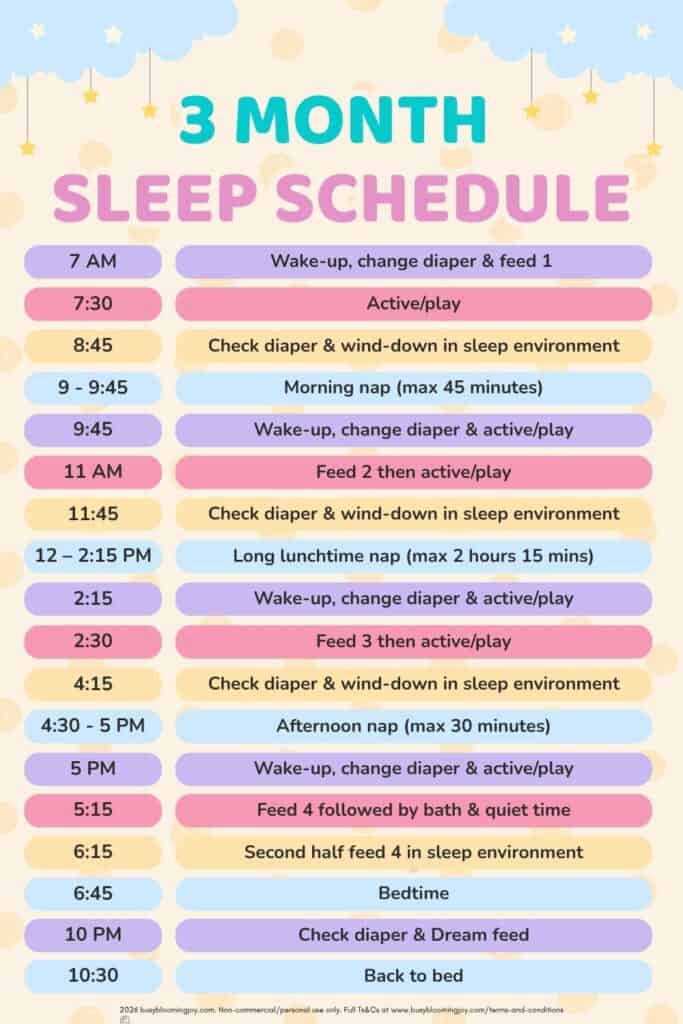
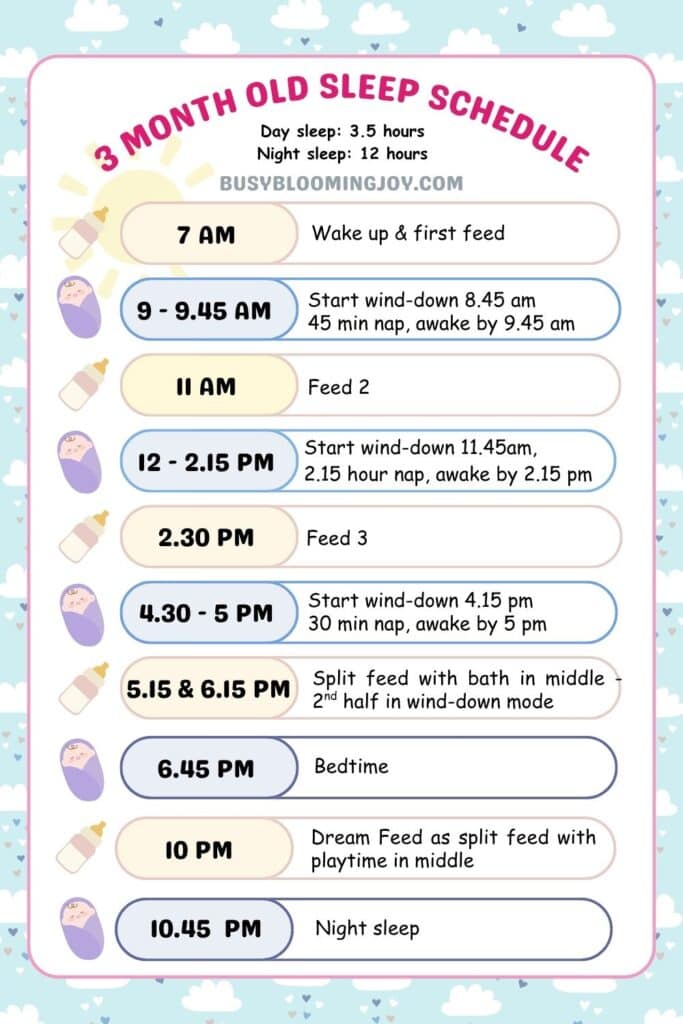
This sleep schedule for a 3 month old is based on a 7am wake-up.
Shift everything forward or back to match the time that suits you to start the day.
| 7:00 am | Wake-up, change diaper to start FEED 1 at 7 am |
| 7:30 am | Active / play |
| 8:45 am | Wind-down in sleep environment |
| 9:00 am | NAP 1: Morning nap (max 45 minutes) |
| 9:45 am | Wake-up, diaper & active / play |
| 11 am | FEED 2 |
| 11:45 am | Wind-down |
| 12:00 pm | NAP 2: Lunchtime nap (max 2 1/4 hours) |
| 2.15 pm | Wake-up, diaper & active / play |
| 2.30 pm | FEED 3 |
| 4:15 pm | Wind-down in sleep environment |
| 4:30 pm | NAP 3: Afternoon nap (max 30 minutes) |
| 5:00 pm | Wake-up, change diaper & active / play |
| 5:15 pm | FEED 4 (1st half) |
| 5:30 pm | Bath & quiet time |
| 6:15 pm | FEED 4 (2nd half) in wind-down mode |
| 6:45 pm | Bedtime |
| 10:00 pm | DREAM FEED & back to bed |
Download FREE 3 Month Schedule PDF here
Understanding Split Feeds
A split feed is when you divide a feed into two halves with a break in between.
Instead of offering the full feed in one go, you give the first half — one breast, or half the bottle — take a break, then offer the second half later.
The break allows your baby to build a little more appetite, meaning they drink more in total at the second sitting. A fuller tummy means a longer stretch before the next feed — and a longer sleep.
Feed 4 is a split feed
The first half of the feed is given at 5.15 pm, before the bath. Then once baby is changed, swaddled and in her sleep space, the second half is given at 6.15 pm in full wind-down mode.
Baby then settles for her first night sleep and — with a full tummy — should sleep through to the Dream feed at 10pm.

The “Dream Feed” at 10pm — may be best as a split feed
As it’s name suggests, the “dream feed” is feeding baby in a dream like state, so there’s no lengthy wake time and then winding down.
This is a really effective way to top baby up before your own bedtime. So you give baby a quick dream feed and then go straight to bed. this maximises the sleep you should get, as the aim is to delay the first night waking.
However, if your baby is too sleepy to take a decent feed then this is all a bit pointless.
In this case you try this feed as a split feed. This will give your baby a chance to stay a little more alert and eat a bit more. Then sleep a longer stretch afterwards.
Here’s how it would go:
- 9.50pm: wake baby, change diaper, 10 minutes of gentle activity to get baby properly awake
- 10pm: first half of the feed
- 10 minutes of activity to rouse baby again
- Check diaper
- Take to the sleep space and swaddle
- 10.30–10.45pm: second half of the feed
- Settle by 11pm
For more tips on getting the dream feed right, read: The dream feed: an insanely simple solution to dramatically more sleep.
The other option is to go to bed asap after bedtime, but you have the energy to stay up for anything length of time, I’d work on getting that dream feed established.
The Long Lunchtime Nap
The most restorative nap of the day is that big middle-of-the-day stretch, just over 2 hours.
This is the nap that really helps your baby (and you!) recharge.
However, it doesn’t always come naturally – many babies naturally tend towards a long morning nap. Which then normally means a very long and often testing afternoon and evening, even with a short nap or two!
Trust me, follow this baby sleep schedule, with its long lunchtime nap and you’ll have a content and happy baby for the rest of the day.
. So, there are three keys to establishing this long lunchtime nap:
- Keeping the morning nap short, which means a maximum of 3o minutes at 3 months. This should give your baby just the right amount of sleep drive to fall into a good long stretch for the lunchtime nap (nap 2).
- That all important sleep space as described above that eliminates disturbances.
- Pause if baby wakes. Wait a few minutes to see if baby will settle back to sleep on their own.
If baby is waking early from the lunchtime nap and is hungry, try offering a small “top-up” feed at 11.45 pm. This may help establish this nap.
If baby refuses a top-up and wakes early from the nap, try settling baby back to sleep with a little milk.
Struggling with short naps? The post linked has 9 practical tactics that actually work.
Download FREE 3 Month Schedule PDF here
Implementing The Schedule In The Beginning
Starting this 3 month baby sleep schedule can seem pretty daunting, especially if the core concepts that make up the 3 part framework are new to you. There’s a lot of new stuff going on!
There’s an easier way….
With all 4 of my babies I’ve used the buggy, baby carrier, car (basically whatever it takes) to get naps established and roughly in line with the scheduled timings.
In time, you can remove those sleep aids – you’d be surprised how the routine sticks!
So if you need sleep aids to get started — use them.
Just try to remove them as soon as you can.
Removing sleep aids
Once nap times feel established — usually after a few weeks — try to gradually drop the sleep aids.
Don’t try to remove them all at once.
Start with the nap or bedtime where your baby settles the easiest. Try putting her down a little less asleep than usual — drowsy but still aware. If she fusses, go back to what works. Try again in a few days.
The goal is to slowly inch toward baby falling asleep with less and less help from you.
The 3-4 Month Sleep Regression
Sleep begins to mature between 3 and 4 months. Unfortunately this can cause sleep to regress, as this is when sleep associations can develop.
A sleep association is anything that baby associates with going to sleep.
So whatever baby associated with falling asleep at the beginning of sleep or naptime he or she will need to fall back to sleep.
- This will include white noise, darkness, swaddling, a wind-down routine – positive associations.
- But also feeding, rocking, being held or something else that requires mom or dad – negative associations.
When sleep cycles start to mature, your baby will be much more likely to wake fully at the end of a cycle which often means multiple times a night — even if not hungry, uncomfortable, and still tired.
Helping your baby back to sleep every time will start to become pretty exhausting!
Avoiding the 3-4 month sleep regression
Get the following in place now before sleep matures, and things will be a lot easier i.e. sleep won’t regress!
- maximise positive sleep associations – get baby’s sleep space and wind-down routine nailed
- minimise negative sleep associations – give your baby the chance to settle without your help as much as possible, as outline above (removing sleep aids)
The other piece of the puzzle is to “pause” if baby stirs.
The”pause”
When your baby stirs or fusses at the end of a nap — pause before going in.
Wait a minute or two. Babies are noisy sleepers and your baby may not even be properly awake. If you rush in too quickly, you risk waking her fully when she might have drifted back off on her own.
This pause is a simple way to encourage self-settling — you’re giving your baby the chance to fall back to sleep without your help.
If baby escalates and it’s clear she needs you, go in. But just take a minute first, you might be surprised!
More Tips For Making The 3 Month Old Sleep Schedule Work
If you have errands to run, a school run to do, or another little one to juggle, sticking to exact timings every day may well be impossible.
Here are some tips for those messier days as well as some for other common obstacles like growth spurts.
Time car journeys with nap times where you can
If your baby falls asleep in the car, your carefully planned nap schedule can go straight out the window!
If yours is a baby who drops off in the car (not all do), try to plan journeys to coincide with a scheduled nap time. That way you won’t go too far off the scheduled timings.
Don’t miss feeds — even if timings slip
If you get behind on the schedule, do whatever you can to catch up on feeds. Do not skip a feed.
Any milk missed in the day will be made up for at night — guaranteed. Feed times are the most important thing to protect, even if nap timings have gone a bit off.
Keep an eye on total daytime sleep
When things go off course, try to avoid your baby sleeping too much in the day overall.
Too much day sleep almost always means more night waking. If a nap has run long, cut the next one a little shorter to compensate.
Flex around growth spurts
Growth spurts can temporarily throw everything off.
Your baby will want to feed more, may be fussier, and may sleep differently for a few days.
Don’t panic — just go with it, feed on demand, and get back to the schedule when things settle. Start each day fresh.
If baby is very gassy, colicky or has reflux try to get to the
Adjusting The Schedule To Suit Your Baby
Every baby is different — some need more sleep, some less. Some can go longer between feeds, especially formula-fed babies.
Think of the schedule as a framework, not a fixed rule. You may find you need to adjust the nap timings while keeping feed times the same, or stretch feeds further apart while keeping naps in place. Be led by your baby.
Signs your baby needs less day sleep
- Waking more at night, or taking a long time to settle after night feeds
- Waking early from day naps for no obvious reason — not hungry, not uncomfortable
Signs your baby needs longer between feeds
- Not hungry at scheduled feed times
- Not drinking as much as usual at a feed


How Long Until My 3 month Old Sleeps Through The Night?
My first two (breastfed) babies started sleeping through the night (from the Dream feed to 7am) at 3 months old following this exact schedule. The twins weren’t that far behind.
It’s absolutely possible your baby sleeping through isn’t far away. But it takes consistency. The foundations you lay now, with a solid schedule, good nap habits, and a wind-down routine, are exactly what gets you there.
For my top 10 tips on getting baby to sleep all night, head to these 10-step no-cry sleep strategies.
Nap Schedule Changes To Make From 3 Months to 4 Months
As your baby grows, sleep needs will reduce just a little and they should be able to manage a little longer between feeds.
Look for signs your 3 month old is ready to cut back on naps:
- Waking early from day naps or mid-nap and not hungry
- Taking a long time to settle for naps and at bedtime
- Waking up more at night and/or taking a while to settle after night feeds
When cutting back naps, protect the long lunchtime nap and bedtime.
- If your baby is hard to settle for the lunchtime nap (nap 2), start cutting down nap 1.
- If your baby is not tired at bedtime and settling long after 7pm, cut down the late afternoon nap (nap 3) down even further and/or remove altogether. A 10 minute doze on a walk in the buggy may do the trick. (If you remove this nap altogether you may need to start feed 4 early and/or put baby to bed earlier.)
When cutting back naps, adjust slowly, by a few minutes every day,
Here are a summary of nap schedule changes from 2 months to 3 months:
| 3 month schedule | 4 month schedule | |
| Nap 1 | 45 minutes | cut to 3o minutes |
| Nap 2 (lunchtime) | 2 1/4 hours | keep at 2 1/4 hours |
| Nap 3 | 20-30 minutes | cut to 10 minutes/remove |
Feed Schedule Changes To Make From 3 Months to 4 Months
Look for signs your 3 month old is ready to increase time between feeds:
- Not hungry when the scheduled feed time arrives — turning away, showing little interest, taking only a small amount
- Not finishing feeds — drinking less than usual at a scheduled feed
- Waking later than usual from naps, making the next scheduled feed feel too soon
- Becoming a more efficient feeder — taking a full feed in less time
Here are some tips for delaying feed times:
- Stretch feed times gradually, a few minutes every day
- Never push feeds back so that baby becomes frantic with hunger — a frantically hungry baby gulps, swallows more air, and is harder to settle
- The key rule is always be led by your baby
Here are a summary of feed schedule changes from 2 months to 3 months:
| 3 month schedule | 4 month schedule | |
| Feed 1 | 7:00 am | 7:00 am |
| Feed 2 | 11:00 am | 11:00 am |
| Feed 3 | 2:30 pm | 2:30 pm |
| Feed 4 (1st half) | 1st half 5:15 pm 2nd half 6:15pm | Push 1st half back, then drop, so single feed at 6pm |
| Dream Feed | 1st half 10 pm 2nd half 10:30 pm | If feeding as a split feed, by 4 months consolidate to 1 feed |
More 3 MONTH OLD Schedule Download Options
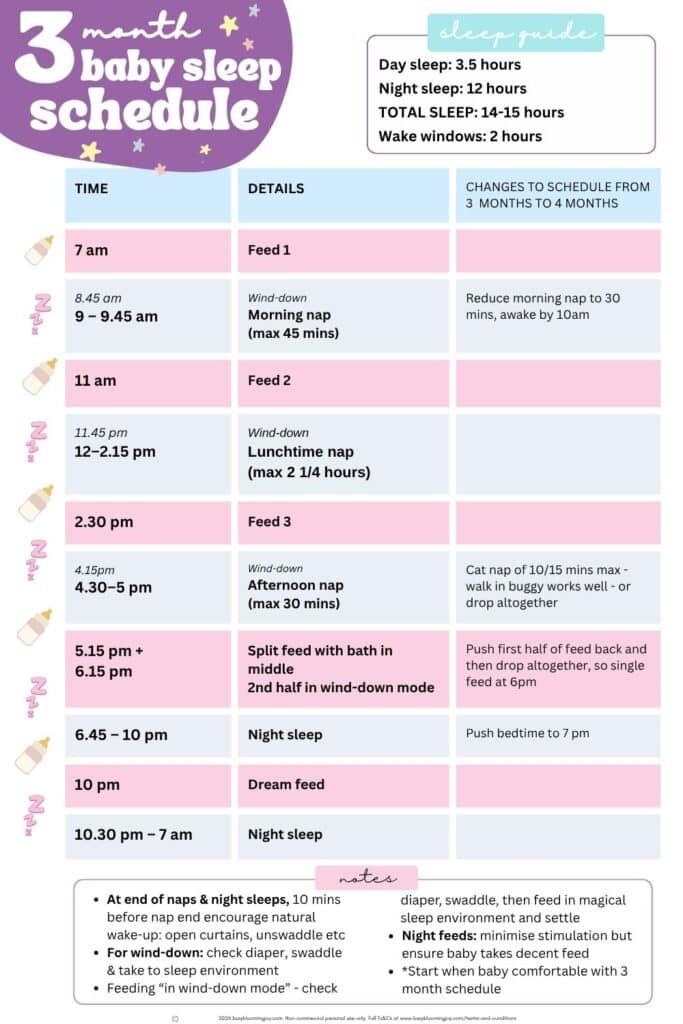
Download more 3 Month Sleep Schedule for FREE here
Ready to move to the next schedule?
Once your baby is approaching the timings on the right of the above tables, it’s time to transition to the 4 month sleep schedule.
Don’t rush it — be led by your baby, not the calendar!
More posts you’ll love:
- A newborn sleep & feeding schedule: 2 weeks to 3 months
- Newborn sleep patterns decoded
- 9 reasons baby wakes at night & how to fix them
- Baby wakes after 30 minutes at night: 7 ways to fix it
- 9 baby sleep mistakes (that I totally made too)
- 25 newborn baby tips for the first 6 weeks
Happy sleeping! 🌙