

Welcome to life with your brand-new bundle — where days blur into nights, coffee becomes a food group, and you can’t remember when you last showered….
Firstly, fear not – this is totally normal! And probably overwhelming…
You may be wondering “Am I doing this right?” — I was.
Maybe you’ve heard people talk about routines and newborn schedules and you’re wondering what, why and how to try one?
This post outlines a simple and sanity-saving rhythm to guide your day for those early weeks with your tiny baby.
“Newborn schedule” is too rigid a term. Here, we’re talking something flexible, gentle, and realistic for both you and your newborn.
This will help you understand your newborn’s natural patterns, support the development of healthy baby sleep habits and guide you through the day. It’ll hopefully make life feel just a little more predictable and a lot less chaotic!
Ready? Let’s dive in.
What To Expect From Birth To 2 Weeks
Whether or not this is your first baby, the first few weeks are a bit of a whirlwind. It’ll probably feel like everything is all over the place and that’s ok and normal!
Before we get into the schedule/routine/daily rhythm, here are a few things to expect in those first 2 weeks.
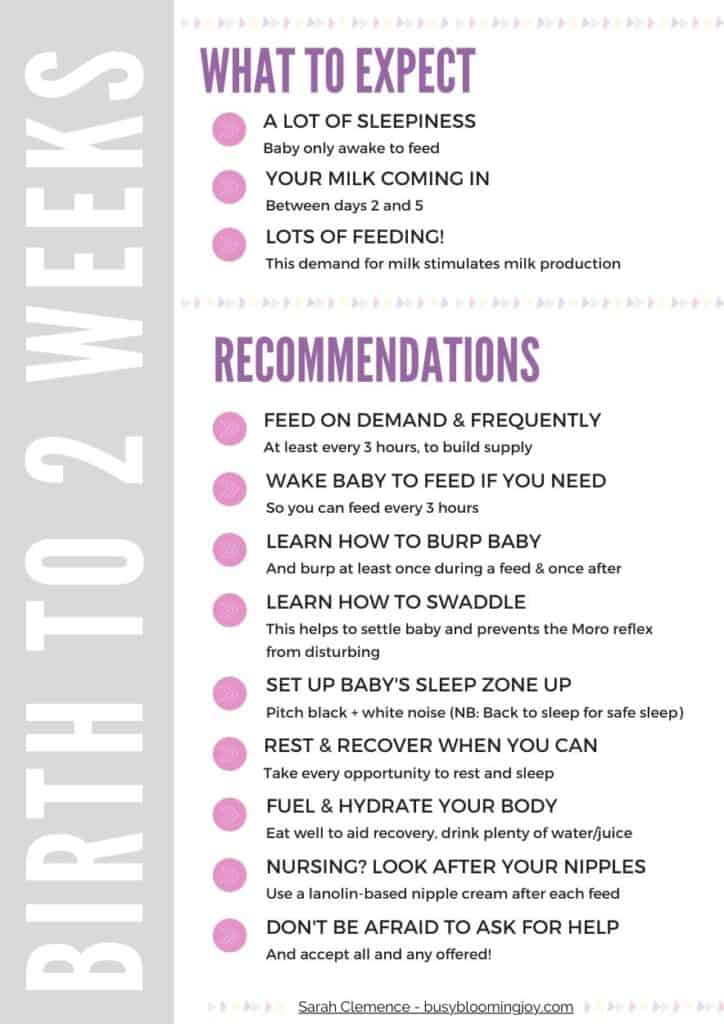
- a lot of sleepiness
- your milk coming in
- your baby wanting to eat all the time
A LOT OF SLEEPINESS!
Your newborn is likely to sleep a lot, 18+ hours a day, waking only to feed. Once your milk has come in, feeds can be long and slow or just very frequent so don’t be surprised if you only have a few minutes of eyes open when not feeding…
Enjoy this, and use this time to get some rest, eat etc, it won’t last that long!
YOUR MILK COMING IN
This should happen between days 2 and 5. It’s important to feed your baby frequently and on demand to stimulate that first milk and build your supply.
YOUR BABY WANTING TO EAT ALL THE TIME!
Your baby’s demand for more milk will stimulate milk production if your breastfeeding, and may well include long periods of cluster feeding, where baby won’t be satisfied unless attached to you!
It’s tiring and will make you extremely hungry and thirsty, but it’s totally normal necessary to establish breastfeeding. Just hang on in there!
CLICK THIS LINK TO DOWNLOAD THIS PDF FOR FREE
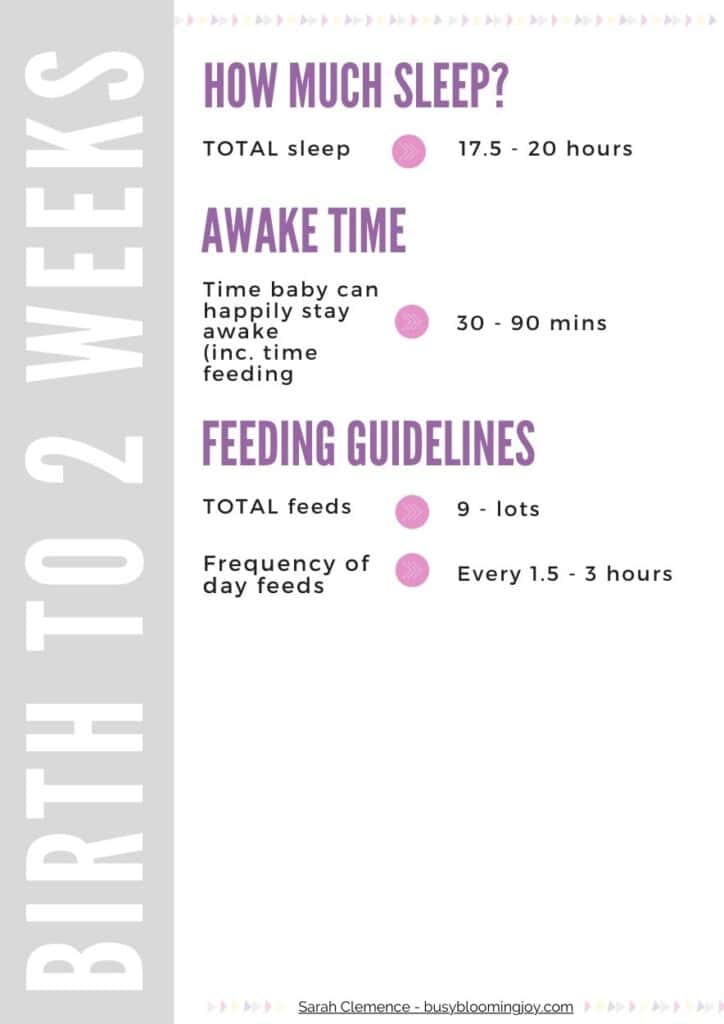
Sleep & Feeding Expectations Birth to 2 Weeks
Daily sleep needs
- Total sleep: 17.5 to 20 hours
Awake time
- Total amount of time baby can stay awake happily (including time spent feeding): 30 to 90 minutes
Daily feeding guidelines
- Total feeds: 9-lots!
Frequency of feeds: every 1.5 to 3 hours
Your Daily Newborn Schedule Birth to 2 Weeks
The first few days and weeks can feel one blur of feeding and diaper changes, with the odd essential clothes change, for both of you!
Your daily newborn schedule at 0-2 weeks will likely be milk → sleep → milk → sleep and so on…
You may find your newborn is barely awake, other than when eating, and even then, is eating while apparently asleep! This is completely normal.
As soon as your baby is able to spend a little time awake, you want to be aiming for: milk → awake time → sleep → milk which you repeat through the day.
This probably won’t happen until week 2, so is covered in detail in the 2-3 week section below.
Don’t skip ahead, continue on to read about the important things to focus on in these first couple of weeks.
What To Focus On From Birth to 2 Weeks
- feed on demand – frequently (at least every 3 hours) – as and when your baby wants
- wake baby to feed if necessary (make sure your baby eats at least every 3 hours)
- learn how to burp your baby – this is really important for a happy newborn. Try to burp your baby at least once during a feed as well as afterwards
- learn how to swaddle – great to soothe your newborn, settle to sleep and prevent disturbance due to Moro reflex.
- set up baby’s sleep zone – as soon as your newborn is a little more alert (around 2 weeks), you want to ensure the place they sleep in is free from disturbance, so pitch black with white noise. This’ll help your baby sleep long periods and eventually sleep through the night. For specifics, check out tip no. 7 in this newborn baby tips post.
NB: Also remember “back to sleep”: place baby on their back for safe sleep.
CLICK THIS LINK TO DOWNLOAD THIS PDF FOR FREE
And some for you:
- Rest and recover whenever possible: Your body’s been through a major event — whether birth was vaginal or via C-section, recovery takes time. Sleep when you can and hand baby over when possible.
- Fuel and hydrate your body: Eat nourishing foods to support healing (and milk supply if breastfeeding). Keep water or juice nearby and drink after every feed to stay hydrated.
- Use a lanolin-based nipple cream after each feed if nursing, to prevent soreness.
- Care for yourself and ask for help: and don’t hesitate to ask for support — whether it’s with feeding, rest, or your own wellbeing.
For more on the first couple of weeks, check out this post: Are the first two weeks with a newborn the hardest?

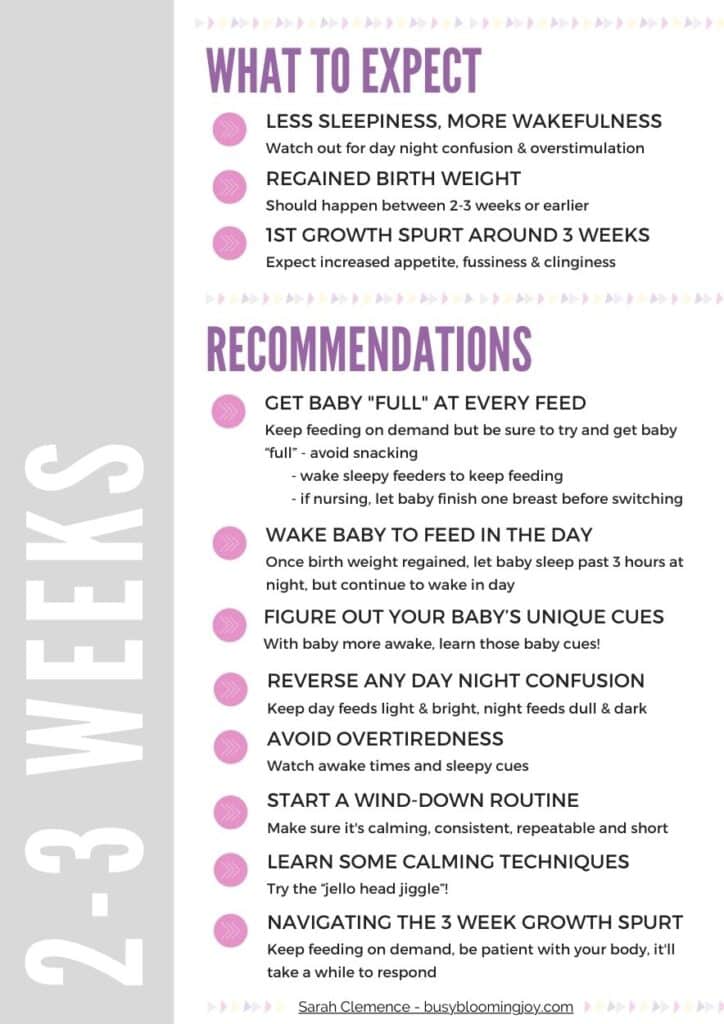
What To Expect At 2 to 3 Weeks
LESS SLEEPINESS, A LITTLE MORE WAKEFULNESS
In the first 2 weeks you’ll probably find your newborn is extremely sleepy, only waking to feed before falling back to sleep.
At around the 2 week mark, baby should start to be a little more awake and alert at times. Which means two things:
- “Day night confusion” can emerge, when baby is wakeful and alert at night but only wakes in the day to feed
- Baby can be easily excited and stimulated by all the goings on in the big outside world and so can become overstimulated and overtired easily (something you want to avoid)
REGAINED BIRTHWEIGHT
Your baby should have regained and surpassed her birthweight somewhere between 2 and 3 weeks, or it may have happened a little earlier. (Source)
A GROWTH SPURT AT AROUND 3 WEEKS
At 3 weeks your newborn will have her first major growth spurt, which will probably last 3-7 days.
Your baby will want to eat more and may be fussier or clingier than normal. In addition, she may go back to sleeping more but also waking more frequently.
However, this early on, sleep and feeding can be so unpredictable you may not even notice this growth spurt.
CLICK THIS LINK TO DOWNLOAD THIS PDF FOR FREE
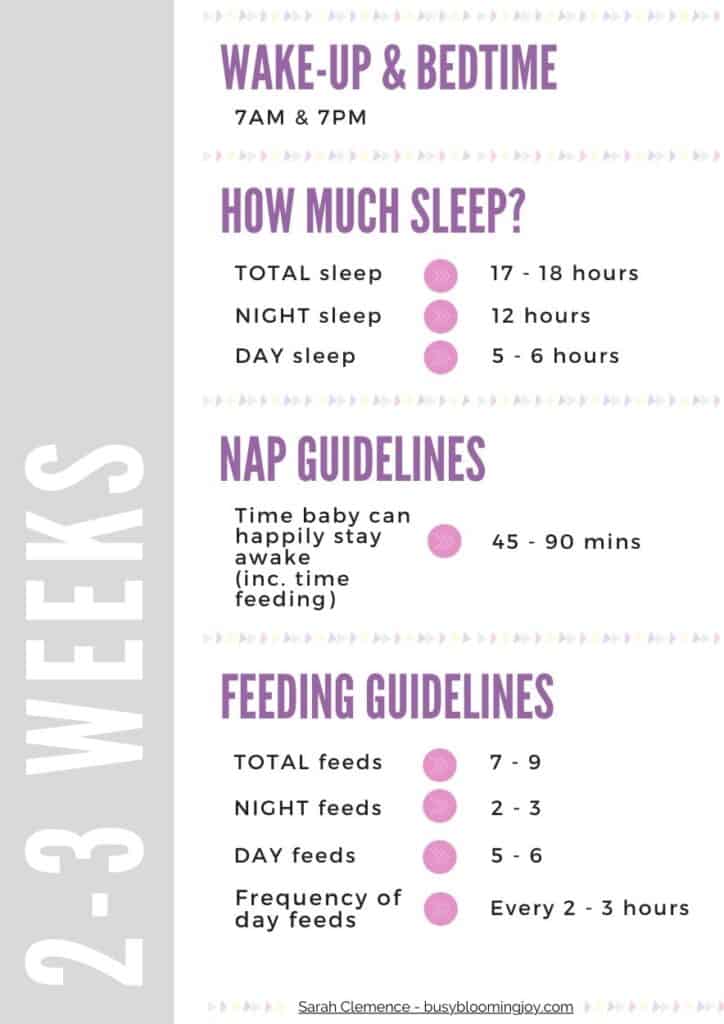
Sleep & Feeding Expectations For Newborns 2 to 3 Weeks
Daily sleep needs
- Total sleep: 17 to 18 hours
- Night sleep (7 pm to 7 am): 12 hours
- Day sleep (between 7 am and 7 pm): 5 to 6 hours*
*If these are wildly off and your newborn is sleeping a lot more than 6 hours in the day, “day night confusion” is probably the issue. Learn how to fix day night confusion here.
Awake time
- Total amount of time baby can stay awake happily (including time spent feeding): 45 to 90 minutes
Daily feeding guidelines
- Total feeds: 7-9
- Night feeds: 2-3
- Day feeds: 5-6
Frequency of feeds: every 2 to 3 hours
Your Daily Newborn Schedule for 2 to 3 Weeks
Now that your newborn is staying awake a little bit more, you want to encourage a period of activity after eating. The number 1 reason is that your newborn will eat more efficiently having just woken from a nap, leading to a fuller tummy and longer stretches between feeds.
This is a very simple and gentle sleep training baby strategy that helps build healthy sleep habits.
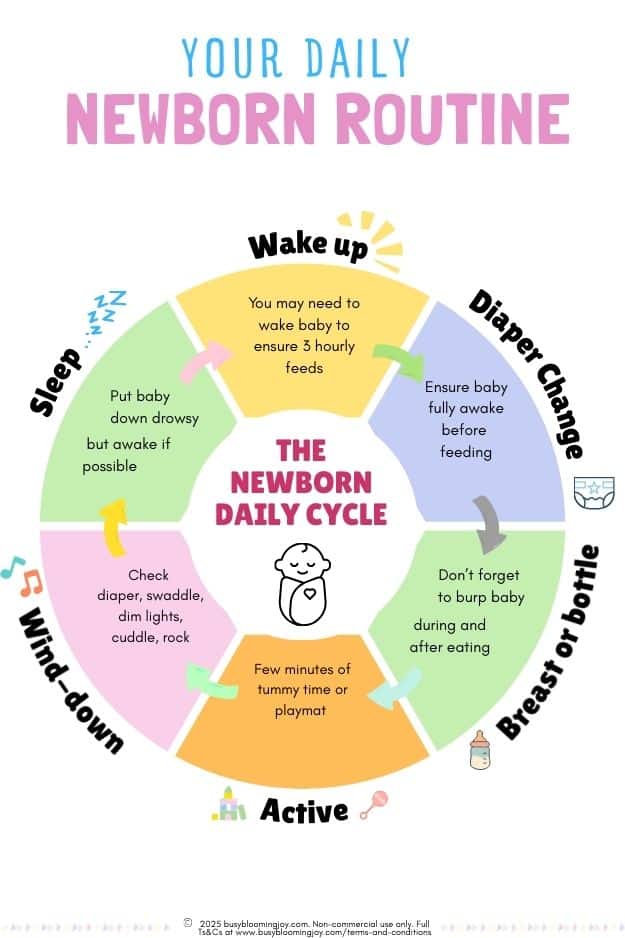
So the cycle is as follows:
milk → awake time → sleep
This repeats throughout the day.
CLICK THIS LINK TO DOWNLOAD THIS PDF FOR FREE
One Routine Cycle
In more detail, the milk → awake time → sleep cycle involves the following steps.
1. Wake up
Your baby wakes naturally from a nap — or you gently wake your baby if it’s time for a feed. You can do this:
- open the curtains up or turn the lights on
- unswaddle baby
- pick baby up, talk to her
- lie her on her blanket or playmat and let her kick about
2. Diaper change
A quick diaper change helps your baby fully wake up and sets the stage for a more effective, alert feed.
If still very sleepy, you can also try taking a layer of clothing off and giving your newborn a quick wipe with a warm, wet cloth to hands, feet, face and diaper area (this is called a “top-and-tail”)
3. Milk
Babies are most alert right after waking, so more likely to take a good, “full” feed so this is the time to feed.
Offer a full breast or bottle feed, remembering to stop and burp at least once during as well as afterwards. (See the section above or check out these baby burping tips.)
4. Awake & active time
After feeding, encourage a brief period of alert time. In these early weeks, this may only be a 5-10 minutes — a bit of tummy time, gentle play, or cuddles.
5. Wind-down
Quick nappy check before settling baby. Swaddle baby snugly and move into a calming, low-stimulation environment — dim lights, put your white noise on, cuddles.
6. Settle to sleep
Lay baby down drowsy but awake if possible, or gently rock to sleep if needed.
And Repeat
The cycle repeats every 1.5–3 hours.
As your baby grows and develops, the cycles should naturally become longer in time, so feeds are a little less frequent. E.g. feeding every 1.5 hours to every 2.5 hours and so on.
Naps may also increase in length, but be careful not to let your baby sleep too much in the day! 5.5 to 8 hours of sleep between the hours of 7 am and 7 pm.
If your baby is waking at night and not settling quickly back to sleep after eating, and is well burped and otherwise comfortable, then they’re probably sleeping too much in the day.
What To Focus On With Your 2-3 Week Old
- Feed on demand & aim for full feeds: Encourage baby to take a full feed every time (especially now they’re more awake) – you want to avoid frequent snacking. Aim to feed every 2.5/3 hours (remember to time from the start of the feed to the start of the next feed). For full feeds:
- Wake sleepy feeders: Gently wake baby if they’re falling asleep mid-feed — this applies during the day and at night to ensure they can manage a reasonable length of time before the next feed.
- If breastfeeding: Let your newborn fully finish one breast before switching to the other, so they get the fattier and more filling “hindmilk”.
- Wake baby to feed in the day: Once birth weight is regained, let baby sleep longer at night — but make sure you feed every 3-hours in the day to minimise night wakes to feed.
- Learn baby cues: As baby becomes more alert you can start to figure out their language. Learning the “baby cues” specific to your newborn will help you respond appropriately. E.g. wriggling and face scrunching down and the “eh” sound probably means your baby needs to burp.
CLICK THIS LINK TO DOWNLOAD THIS PDF FOR FREE
- Reverse day-night confusion: Keep day feeds bright and engaging, and night feeds quiet and boring.
- Avoid overtiredness: At 2-3 weeks old, your baby still won’t be able to stay awake very long, 45–90 mins. This includes the time spent eating. So watch for “sleepy cues” and settle baby before overtired.
- Start a wind-down routine: Keep it short and consistent — dim lights, change diaper, swaddle, cuddle or rock, white noise on, into cot. This’ll help settle your newborn and, in time, will also help signal sleep time.
- Learn some calming techniques: If baby’s fussy, try extra soothing like the “jello head jiggle” to initiate the calming reflex (explained in this calming baby post).
- Navigating the 3 week growth spurt: Expect cluster feeds and extra sleep needs around week 3. Stick to demand feeding and avoid formula top-ups if breastfeeding — your supply will catch up, just be patient, keep well hydrated and give your body chance to catch up.
FAQS for your daily newborn routine from 0 to 3 weeks
Help, my baby won’t stay awake after feeding!
Don’t worry! In the early days, your baby might only be awake 30–45 minutes at a time, that includes time spent feeding.
So if your newborn spent 45 minutes feeding, then they might be straight back to sleep. That’s quite normal and nothing to get stressed about.
My baby is always asleep by the time I’m done and I never put her to sleep drowsy and awake.
Again, nothing to worry about at this age.
My baby won’t settle, is fussy and uncomfortable.
Gassiness, colic or the witching hour may be to blame. Check out these posts:
- Got a gassy baby? 16 Common causes & remedies to fix them for good
- Colic: what is it & is crying really inconsolable? Plus causes & remedies
My baby is so wide awake and alert, should I keep her awake longer so she sleeps longer at night?
Avoid long wake windows. Even at 3 months, max awake time is around 2 hours (including feeding).
What’s next?
If you want to progress to a schedule with fixed feeding and nap times that encourages a longer lunchtime nap, and your baby is now feeding every 3 hours, check out this newborn sleep and feeding schedule.
25 Newborn Baby Tips For The First 6 Weeks
https://busybloomingjoy.com/newborn-baby-tips-birth-to-3-weeks/
(companion general tips post — great foundational link)
New to parenthood? Check out these baby tips:
- 25 Newborn Baby Tips For The First 6 Weeks
- 3 To 6 Weeks Newborn Schedule: A Simple Daily Routine
- Baby sleep strategies: How to help your baby sleep through the night
- 9 Reasons Baby Wakes Up At Night & How to Fix Them Fast
- 9 Baby Sleep Mistakes (That I Totally Made Too)
- No-Cry Baby Sleep Training: 10 Gentle Newborn Sleep Tips & Baby Advice